
 | ||||

a. Victoria: largest opium making center outside Asia [posted 11/16/09; updated
8/22/12]a*. Canada's other opium makers: Vancouver, New Westminster, Nanaimo [posted 01/09/11]
b. Refining and packaging opium for sale 提煉. 包装 [posted 8/9/09]
c. Opium brand names [updated 11/16/09]
d. More opium brand names: from gold mining sites in the Cariboo [updated 01/18/10]
d1 Even more opium brand names, from Idaho's AACC [posted 3/3/11]
d2 Opium brands from Australia [posted 2/6/12]
d3 More opium brands from Australia: the Hong Kong-North American connection [posted 2/23/12]
d4 The best-dated opium brands: from railroad camps in Montana [posted 3/6/12]
e. Opium cans or "tins" [posted 8/14/09]
f.. Opium cans of the prohibited period, mostly from Macao [1/17/11, revised 2/14/13]
f1 Kwangchow-Wan brands and the French connection [posted 1/17/11, revised 3/26/13]
f2 Opium smuggling and Lam Kee's opium factory in Macao [posted 3/26/13]
g. Fake opium brands in San Francisco [posted 9/6/09]
g1 Counterfeiting Hong Kong opium [posted 9/15/12]
g2 Paper Labels on Opium Cans [posted 4/18/11]
h. Commercial trickery in Canadian opium labeling [posted 12/28/10]
i.. Opium retailers in San Francisco, 1900-1904 [posted 12/17/09]
j.. Triumph of 19th century chemistry: making Middle Eastern opium smokable [posted 12/29/09]
k. Direct evidence of a Middle East/Balkans to Pacific Northwest connection [posted 12/29/09]
l. A public-spirited narcotics cartel? The modest profits of Victoria's opium refiners [posted 08/21/12]
m. Chinese sources for opium market prices in the U.S [posted 11/29/16]
b. A governor-general and his wife visit a Victoria opium "factory" in 1895 [posted 11/10/09]
d. More smuggling incidents and tales The Great Smuggling Ring, 1893 [posted 12/15/09]
d1. "A prepossessing young widow" from Port Angeles [posted 01/24/12]
e. "The pretty smuggler and her pathetic story" [posted 11/1/09]
f. A fashionable young lady gets caught with a half-ton of opium [updated 12/17/09]
g. Diving for opium in Puget Sound: a true story 打捞 [updated 10/1/09]
3. Opium Use
a. Opium equipment in the U.S., 1896 煙具 [posted 8/1/09]
b. How opium pipes worked [posted 10/8/09]
c. Opium pipe bowls show Chinese immigrants' middle-class aspirations [posted 10/8/09]
d. Connoisseurs' pipe bowls from Yixing and Shiwan 宜兴, 石湾的烟斗 [updated 11/29/09]
e. Brand dominance in the opium pipe bowl trade [posted 10/27/09]
e1 Pipe bowl brands found in both America and Australia [posted 2/23/12]
f. North American opium lamps [posted 11/3/09]
g. Commerce in opium lamp chimneys [posted 12/1/09]
h. An addicted white prostitute testifies, 1885 煙友 [updated 8/17/09]
i. How much opium did white Americans use? The Iowa case [posted 12/19/09]
i-1. Marketing opium to European-Americans before 1914 [posted 7/15/2012]
j.. The opium addicts of Albany, NY [posted 12/21/09]
k. Opium suicides [posted 12/17/10]
L. A British ambassador smokes opium in Oregon [posted 10/7/11]
b. Addiction cures for North American Chinese [posted 10/15/09]
c.. Curing addicts and outlawing the opium trade: the missionary connection [posted 10/19/09]
d. British Columbia defends Britain against Opium War slander [posted 12/28/09]
e. The Addict's Progress: anti-opium propaganda in China, 1883 [posted 04/21/11]
a Lurid pictures of opium dens [posted 05/30/10, updated 04/18/11]
b. Exaggerating harm from opium use [posted 05/30/10]
OPIUM 鴉片煙 IN THE PACIFIC NORTHWEST
1850s-1930s -- Page 2
Making & Selling
Smuggling
Using
Banning & Curing
This page is an annex to the main Opium page, added because loading time was getting too slow. The table of contents below may jump you to either page, depending on content. However, you will find that the main Opium page is better for browsing.
| ||||
Commerce in Opium Lamp Chimneys
Chimneys for opium lamps were almost always made of glass. In North America, as is true of opium pipe bowls and opium itself, such chimneys could not be produced locally and thus had to be imported. Stewart Culin suggested in 1891 (Note 1) that some were re-exports from China, having been shipped there from glass makers in Birmingham, England. Other chimneys, however, like the one illustrated in the North American Opium Lamps article on this website, are made of the bubbly glass that typifies the cheaper products of traditional glass works in China itself.
The Chung Collection at the University of British Columbia (Note 2) preserves a unique set of lamp chimneys in their original packaging, recovered from the 1910s-1930s cache in Vancouver's former Wing Sang store (Note 2). It may be the only such set to have survived anywhere in the world. Three suppliers, who seem to have been manufacturers rather than mere wholesalers, are represented. All were in the city of Guangzhou (Canton): Guang Hua on the north side of Xiajiupu district, Guang Heng in the same district, and Guang An, on the east side of Youlanmen district.
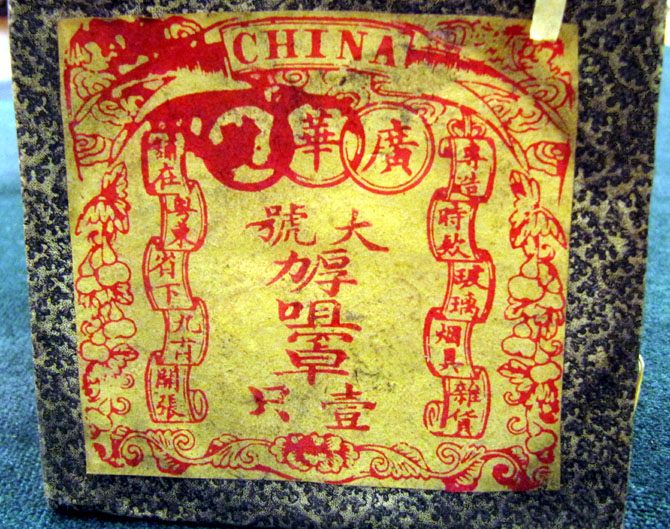
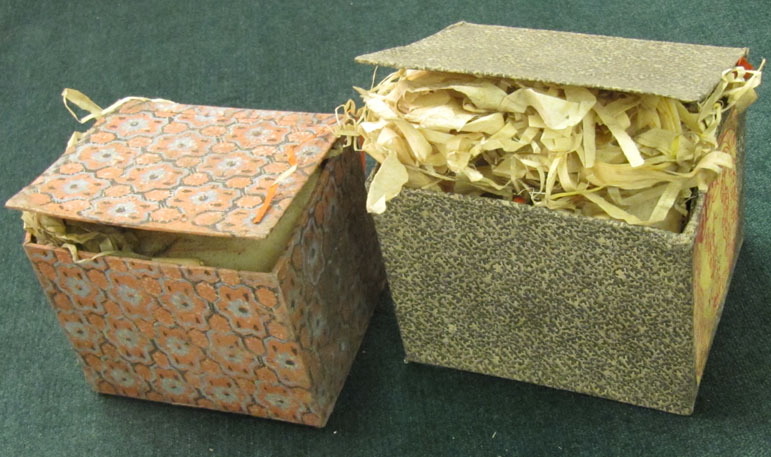
A few of the boxes have woodblock-printed labels. The one above reads "Guang Hua Store, specialized in making fashionable glass, opium utensils, and other things; the store is located in the capital of Guangdong, Xiajiupu district. Large size thickened-rim chimney, one piece" Here, "store" means firm or company. Each box holds one chimney, wrapped in a sheet of coarse paper and then packed in paper confetti.
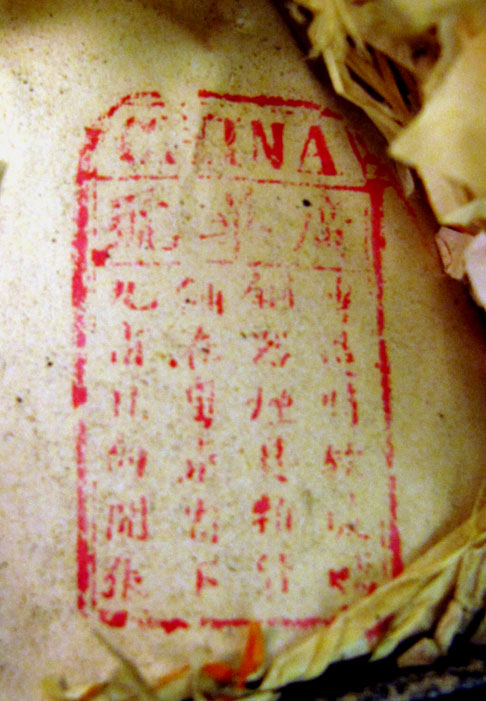
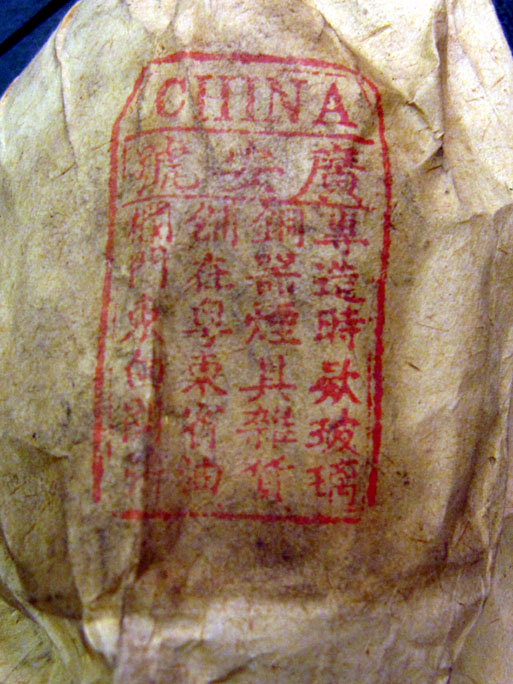
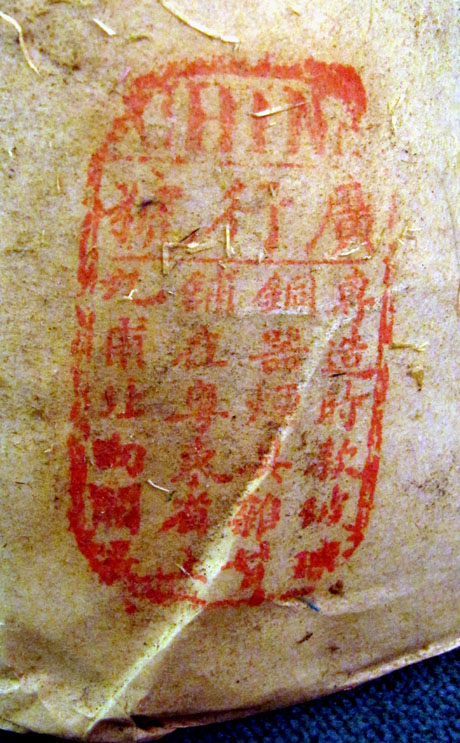
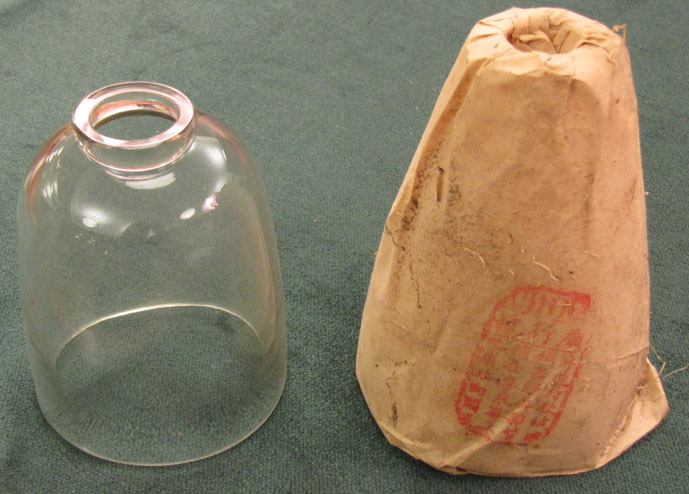
All of the wrapping papers bear stamped seals in red ink that carry the same text as the box labels, except that the contents are not described and, in the case of Guang An and Guang Heng, the store's products are stated to include brass. Box labels and wrappings both include the English word "China," showing that the stores were aiming partly at buyers in the U.S. where, since the passage of the McKinley Tariff Act of 1891, all imports had to be marked with the name of the country of origin.
The presence of McKinley Act markings sets an early limit date for many sorts of Asian artifacts. In this case, the lamp chimneys are later than that. Like the other opium-related objects in the Wing Sang cache, they were hidden, indicating that they post-date 1908, the year when opium for smoking became illegal in Canada.
Note1: For the Birmingham connection, see Stewart Culin, "Opium Smoking by the Chinese in Philadelphia," American Journal of Pharmacy, Oct, 1891, p 499.
Note 2: The Chung Collection materials were kindly shown to the editors by Sarah Romney, Archivist
Note 3: The cache, containing much opium-related material that had once been on sale at the Wing Sang shop (on Pender Street in Vancouver) was discovered in the 1990s. Items from it are in the Chung Collection, the Museum of Vancouver, and the Chinese Pioneer Virtual Museum.
Opium lamp chimney boxes, Chung Collection
Wrapped and unwrapped opium lamp chimneys, Chung Collection
Opium lamp chimney wrappers, Chung Collection. Left: Guang Hua Center: Guang An Right: Guang Heng
More smuggling incidents and tales
(For the first batch of incidents and tales, click here)
Operations of the Great Smuggling Ring
On Nov 26 1893, the San Francisco Chronicle published a well-researched feature article on opium smugglers in British Columbia. It offers fine descriptions of opium smuggling from Canada into the U.S. by land and sea. Although by 1893, almost all imported raw opium entered Canada via Vancouver, most of it was immediately shipped over to Victoria for refining. After that it might be smuggled across the border in small sailboats, hidden on board larger steamers, carried overland through the "almost trackless pine forests of Northern Washington," or shipped further east via the Canadian Pacific Railroad, to be brought into the U.S. at many spots in North Dakota, Minnesota, and the areas south of Toronto and Montreal.
The writer of the article may have had personal experience of smuggling by small boat:
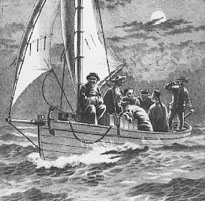
"When the smugglers in Victoria decide to run a cargo of 500 pounds of opium into the United States, they select a dark night with a good breeze blowing. They have previously ascertained by telegraph from confederates in Port Townsend just across the water, the whereabouts and probable intentions of the United States revenue cutter that patrols those waters. The intended landing point is also communicated to the accomplice, and every possible precaution taken to make sure the coast is clear. Then, a little after dark, an innocent fishing boat with a pile of nets conspicuously displayed on deck, a couple of men lounging around and one man at the wheel, slips out of the harbor and stands out into the Straits of Fuca. Down below the five-pound [the writer must mean five ounce--editors] cans of opium are safely stowed away, and three or four hardy fellows are lying low, taking a nap the meanwhile. Once outside the nets are stacked away, even inch of canvas is spread, the men tumble up from below, and the voyage begins in earnest. All lights are extinguished, the utmost silence is preserved, and each man takes his post to keep a bright lookout and to handle the sails in an emergency."
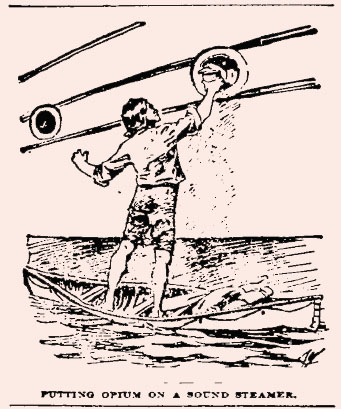
When the weather was too rough for small, fast sailboats, the smugglers used the daily steamers that "ply between Victoria and the cities of Seattle and Tacoma. These steamers are big, handsome floating palaces worthy of the Hudson or Long Island Sound. They leave Victoria after dark, and a little before they leave a Siwash Indian canoe will glide along underneath the wharves and silently slip under the steamer's counter. A port hole will stealthily open and a couple of hundred pounds of opium be shoved aboard and safely stowed away by an accomplice where the inquisitive eye of the customs-house inspector cannot discover it, to be unloaded at Tacoma when favorable opportunity offers."
The writer concludes with a bit of fine writing, indicating (without offering the slightest proof) that that all this activity was under central control:
"The opium ring of the Northwest is a fearful, shadowy, impalpable something; shadowy in form, but most substantial in fact. It makes its presence known, yet is itself unknown. The subordinate members obey a system. They work in unison, yet they know not what is the motive power of this immense machine that is taking opium from British Columbia into the Unites States with almost mechanical regularity, this giant octopus that is sucking in the revenues rightly due the Government and diverting them to its enrichment."
Interestingly, he does not suggest that this octopus was Chinese. In fact he implies strongly that ultimate control of the opium ring was in the hands of a European-American, "some prominent citizen whose reputation in the commercial and social world is untainted." The secret agents of the U. S. government "are baffled and, watch as they will, they cannot find evidence enough to bring this man to justice."
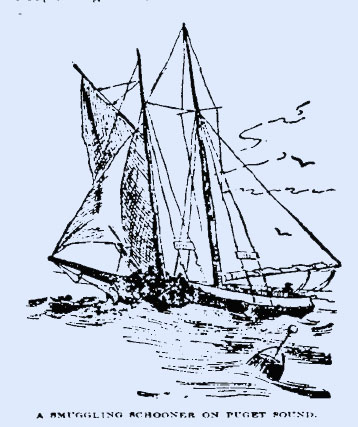
Scene in Victoria Harbor, 1893: The vessels may be those of smugglers
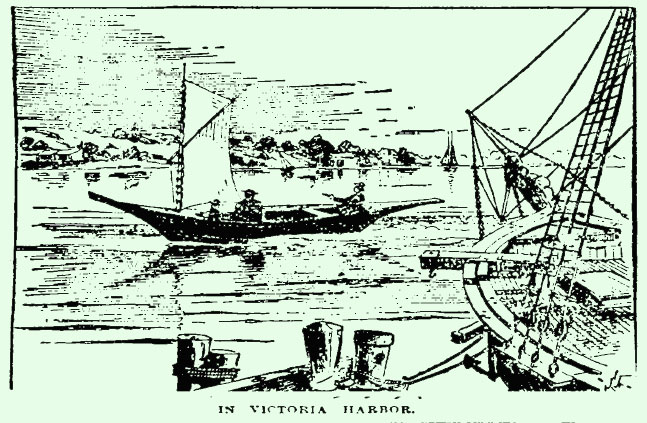
Victoria-based smuggling ship crossing the Strait of Juan de Fuca
Siwash Indian in canoe passing opium to crew member of a Victoria-Seattle/Tacoma steamship
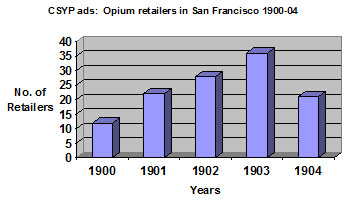
Opium Retailers in San Francisco, 1900 – 1904.
During the years when opium was legal in San Francisco, many grocery stores in Chinatown carried it as standard merchandise, along with rice, tea, oil, textiles, etc. But exactly where and how was opium available before the 1906 earthquake? We looked at ads placed in Chungsai Yatpo between 1900 and 1904, one day for each year, and came up with these conclusions.
1. On average, between 20 and 40 shops in Chinatown advertised that they sold opium at retail.
2. Such shops were concentrated along Dupont (later called Grant) Avenue in the 700 to 1000 blocks, in the 700 blocks of Sacramento and Commercial, and here and there along Washington.
Only 12 opium retailers advertised in the newspaper in 1900, a much smaller number compared with later years. This is likely to have been because Chungsai Yatpo was new to San Francisco, having just moved from Los Angeles that year.
When we include the English-language city directories for 1875 and 1894 in our survey, we find interestingly similar numbers: 20 opium retailers in 1875 and 22 in 1894. One conclusion: opium evidently found a good many buyers who could read English but not Chinese. Another conclusion: selling opium may not have been as profitable as one would think. We find many shops that discontinued advertising opium over time. Only one of the 20 opium retailers in 1875 was listed again in the 1894 city directory. And only three of the 22 opium retailers in 1894 advertised again in local Chinese newspapers between 1900 and 1904.
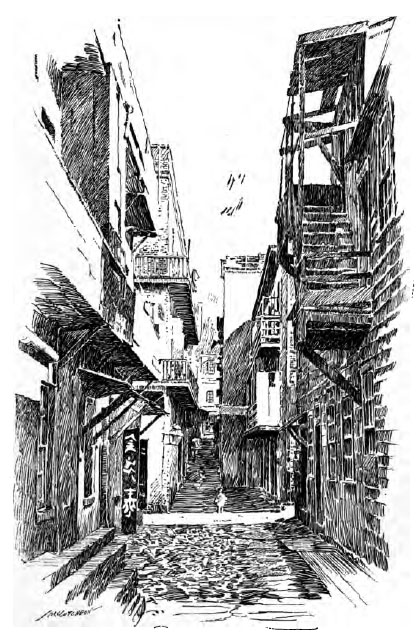
SF Chinatown 1897
Note on illustrations: The chart is by the editors; the drawing is by the great Chicago Tribune cartoonist John T. McCutcheon, from J. A.Higgins, California and Back, Santa Fe Railroad: Chicago, 1897
Quantitative data on 19th century opium use in the U.S. is contradictory. H. H. Kane (1882) quotes the Treasury Department's Bureau of Statistics as saying that in 1880, when the government was still taxing imports of raw as well as refined opium and hence keeping records on both kinds, the U.S. imported 243,000 pounds of raw or “gum” opium, presumably all of it the high-morphine and thus theoretically unsmokable Turkish-Persian-Balkans product, and 77,000 pounds of low-morphine "opium prepared for smoking," most of which came from India via Hong Kong. Considering that much raw opium was used for medical purposes and that Chinese, who must have consumed the bulk of of the prepared opium, constituted less than 1% of the overall American population, it would seem that recreational opium use and addiction were higher among Chinese-Americans than among European- and African-Americans. Those ethnic groups did have their addicts, habituated to the use of Turkish-Persian-Balkans opium in the form of morphine, laudanum, etc. However—if the Treasury Department’s statistics were accurate—, the percentage of white and black addicts had to be lower than among Chinese sojourner-immigrants.
The problem is that we have no way of evaluating the Treasury Department’s statistics. Did it manage to collect duties on a large or small proportion of incoming raw opium? Customs officials were vigilant about the smuggling of refined opium, because when detected it yielded large bounties for offices and individuals. However, contemporary newspapers say nothing about seizures of smuggled raw opium. Perhaps thus was because the duty evaded, and hence the rewards to customs inspectors, were very modest. Before 1890, importers paid $1.00 per pound in duties for raw opium containing “more than nine percentum of morphia.” They paid $6.00 per pound for refined opium with a lower (ideally 3-5%) morphine content. Customs inspectors must have felt that chasing smugglers of high-morphine opium was hardly worth the time and effort.
J. M. Hull's 1885 report to the Iowa Board of Health indicates that much larger quantities of non-smoking high-morphine opium may have been entering the country. He sent questionnaires to the 3000 stores in Iowa that sold opiate drugs. 123 stores responded. They reported a total of 235 addicts (“habitués”), an average of almost 2 per store. 129, a majority, of these addicts were women. 26 injected morphine while the rest took the drug by mouth: 129 morphine, 73 gum opium, 12 laudanum, 6 paregoric, 3 Dovers' powder, and 4 McMunn's Elixir.
Hull extrapolates from his sample to suggest that the existence of 3000 opium-selling stores in Iowa meant that the state had a total of 6000 addicts. At that time, Iowa had a population of 1.7 million, the great majority of whom were white. This would mean that 0.3 percent of Iowans were addicts. China itself as well as Chinese in North America were said to have higher addiction rates: several percent or even more. However, Hull’s figures for whites are surprisingly high. If we accept his calculations, we must conclude that in the 1880s there were as many white addicts in Iowa as there were Chinese, addicted or not, in the whole of Washington State.
To be sure, Hulls’ calculations are no more solid than Kane’s. But they do seem to show that in the 1880s there were a great many white opium addicts in the U.S., that the majority were female, and that nobody worried much about this. The lack of worry was so great, in fact, that under the McKinley Tariff Law of 1890—just when propaganda against opium in Chinatowns was building to a climax—the customs duty on raw high-morphine opium, the kind consumed by whites, was dropped to zero. In contrast, the new tariff for low-morphine smoking opium, as consumed by Chinese, was set first at $6.00 and then at $12.00 per pound. Thus, after 1890, Customs continued to be fascinated by low-morphine smokable opium but ignored imports of high-morphine opium completely. There are no records of quantities imported. The price of such opium undoubtedly fell while quantities rose. Underground chemists, both white and Chinese, must have been working feverishly to learn how to remove most of the morphine from the Turkish-Persian-Balkans drug in order to make it fit for smoking. (They succeeded -- click here for article)
Sources: Harry Hubbell Kane, Opium Smoking in America and China, a study of its persistence and effects, New York: G. P. Putnam's Sons, 1882; J. M. Hull, "The Opium Habit [in Iowa]" Iowa State Board of Health, 3rd Biennial Report, Des Moines, Iowa, 1885; U. S. Congress, New Customs Law of 1890, New York: Belford Co., 1890; Chinese pharmacy image from Harpers Weekly, 1899-12-08, p 1239.
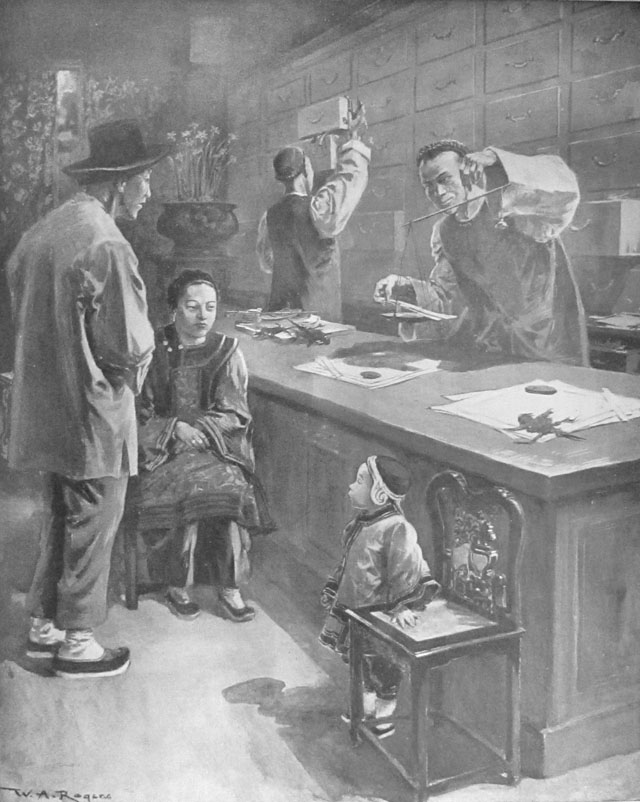
Chinese pharmacy in San Francisco, 1899. Chinese-Americans bought most of their opium from general stores, but many pharmacists undoubtedly carried it
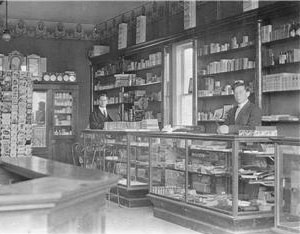
Iowa drugstore, ca. 1900. In the Midwest, the bulk of opium-containing patent and over-the-counter medications were sold in stores like this one
How Much Opium Did White Americans Consume? The Iowa Case
The Opium Addicts of Albany, NY
In 1880, according to the anti-opium writer H. H. Kane, the city of Albany in upstate New York, with a population of 91,000 people, consumed 3,600 pounds of opium and 5,500 ounces of morphine, the latter equivalent to more than 22,000 ounces of opium. Adding and converting to metric weights, this means that Albany’s annual opium-equivalent consumption came to 2,211,000 grams.
Medical needs might have accounted for a third of this total. The indicated consumption of 8 grams per year for every man, woman and child in the city might be on the high side, considering that .064 grams (= 1 grain) of opium was a normal therapeutic dose in those days. However, even if we accept this high estimate, it still leaves 1,470,000 grams for non-medicinal use. Kane quotes studies showing that the median U.S. addict of that period used about 1.3 grams of opium per day or 485 grams per year. It follows that Albany’s total consumption of non-medicinal opium was enough to supply more than 3000 addicts.
That is a lot of addicts. At about six percent of the adult population, the addiction rate for Albany equaled contemporary addiction rates for China itself. And yet, strangely, no one seems to have been greatly concerned. There are few if any contemporary articles deploring the number of dope-crazed Albanites shambling through the city’s streets or warning decent girls against attempts by depraved European-American addicts to lure them into the vile opium parlors of Albany’s British slums.
Part of the reason for this unconcern may be that no one wanted to read about vice among ordinary European-Americans like themselves. Kane’s own groundbreaking book of 1881 on that subject, Drugs that Enslave: The Opium, Morphine, Chloral and Hashisch Habits, seems not to have sold well. Luckily for him, he was far more successful with his next book, Opium Smoking in America and China, which appeared in 1882. Whereas in 1881 he had dismissed Chinese opium use as “confined entirely to the inhabitants of Eastern countries” and consequently as “of no interest to us,” now he recanted that opinion and announced that opium smoking as practiced by the Chinese was a threat to all white Americans, especially ”the over-curious, foolish, indolent, or willfully vicious.” The 1882 book was an instant hit. Over the next twenty years, it would be read and quoted by numerous anti-opium crusaders.
Statistics for opium use in “one of our large cities” with a population of 91,000 in 1880 and for opium consumption by regular, heavy American users, presumably addicts, come from the preface to Kane’s 1881 book and his page 28. His recantation and emphasis on Chinese as purveyors of opium smoking culture to white Americans appears in the preface to his 1882 book. The city, which Kane does not name, is identified as Albany by G. Maxwell Christine in a letter to Medical and Surgical Reporter, 1881, vol 45: p 417. The Albany house image is from American Architecture and Building News,1879-01-22
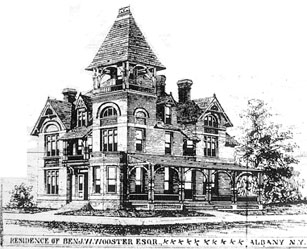
Upper middle class European-American addicts in Albany must have lived in homes like this, built in 1879
1895: British Columbia Defends Britain Against Opium War Slander
The following article appeared on the editorial page of the Victoria Daily Colonist on June 18, 1895
"Britain's Character Vindicated
"Very many people believe that England at one time went to war with China in order to force its government to admit British [-Indian] grown opium into its ports...
"Well, the reproach is undeserved. Great Britain never at any time attempted to force opium into China at the bayonet's point or the cannon's mouth. The London Times, in an article which ought to be read by every Briton who has the reputation of his country at heart, proves to a demonstration that the accusation made, no doubt in the first instance by an enemy of Great Britain and the British, and repeated by thousands of well-meaning persons who bewailed the wickedness and greed of the rulers of the nation, is utterly without foundation."
The article goes on to explain that Britain was not angry at Commissioner Lin Zexu's famous destruction of 20,283 chests (2,697,639 lb or 1,223,628 kg) of opium belonging to British merchants in 1839. At first Britain did not even demand compensation. It was only because of Commissioner Lin's insults to British officials and "fantastical outrages," not because of the opium, that Britain went to war. The war-ending Treaty of Nankin (Nanjing) of 1842, the article states, did not even mention opium except to demand, quite incidentally, "compensation for the opium delivered in March, 1839, 'as a ransom for the lives of her Britannic Majesty's superintendent and subjects who had been imprisoned and threatened with death by the Chinese high officials.' "
The article does not mention the amount of money involved: 6 million dollars (in the then-standard Mexican silver dollars) as the value of the opium plus another 15 million dollars to cover other debts and expenses. The British writer may have regarded this 21 million as a trivial sum. It was a lot on this side of the Atlantic, however. In 1845, the total budget of the federal U.S. government came to 27 million, and that was in lower-valued U.S. silver dollars rather than the purer Mexican kind.
The story of Commissioner Lin and the First Opium War between Great Britain and China has been told many times. Readers will find numerous references by entering those terms into Google, Bing, or any other search engine. They will discover that very few of those references accept the Daily Colonist's point of view. Just about all modern historians believe that Britain did indeed fight the war in part, at least, to "force opium into China at the bayonet's point or the cannon's mouth."
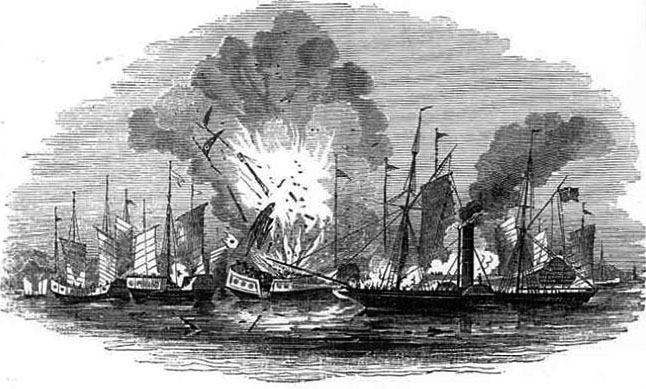
"Not Forcing Opium into China at the Cannon's Mouth," 1842: The steam-powered British warship Nemesis destroys sail-powered Chinese navy junks at the start of the Opium War. Illustrated London News, 1842
No one really knows how much opium was smoked in North America each year. Even making an informed guess is difficult. Up until 1908-1909, when opium for smoking became illegal in Canada and the U.S., we do know how much raw low-morphine opium was legally entering Canada from India via Hong Kong and Macao. We also know how much refined low-morphine Indian opium was coming into the United States from the same sources. We might even be able to estimate how much of those kinds of opium was entering illegally. However, we run into a blank wall when we try to get an idea of the role played by high-morphine opium from Turkey, Persia, and the Balkans, which entered the U.S. duty-free and unrecorded throughout the 1890s and early 1900s.
The problem is that, by then, Chinese-American (and European-American) chemists seem to have learned how to convert high-morphine opium into a product suitable for smoking:
“In violation of the law, the Chinese are able to flood the local market with an inferior kind of drug made out of Persian and Turkish opium. These kinds in their crude form are admitted free of duty because they contain more than nine
percent of morphia. While useful for medical purposes they have been supposed utterly useless for smoking, the excess of morphia producing skin eruptions and headaches when smoked. But the Chinese were not to be outdone. After a good deal of experimenting they have discovered some process by which the excess of morphia is precipitated and a fairly palatable preparation is made.” (Note 1)
One assumes that this palatability was relative. American-refined opium, at least some of it from Southwest Asia and Southeast Europe, still sold for a much lower price than Indian opium as refined in Canada and, especially, in Hong Kong-Macao. Opium refined in the U.S. did exist, however. It may have continued to play a role in the illicit opium trade after 1908-1909, when opium for smoking (but not for drinking and injecting) was banned.
Note 1: Frederick J. Masters, "The Opium Traffic in California," The Chatauquan, A Monthly Magazine, October 1896-March 1897, p 60. The image is from Wikipedia Commons
Triumph of Turn-of-the-Century Chemistry: Making Turkish-Persian-Balkans Opium into a Smokable Product
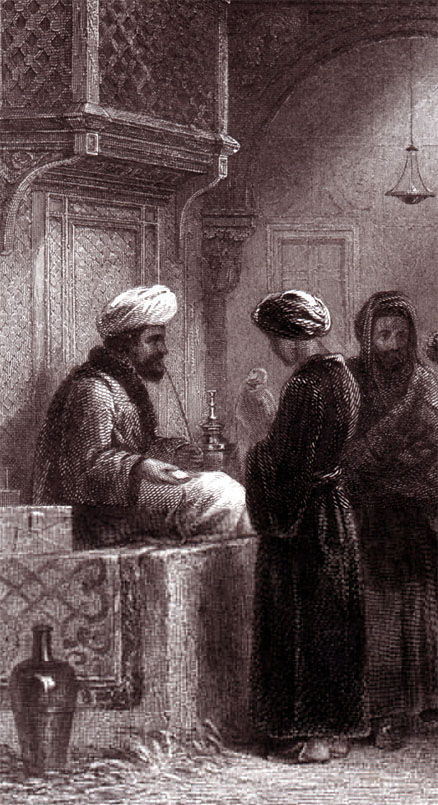
Turkish opium seller, 1845
Direct Evidence of a Middle East/Balkans to Pacific Northwest Connection
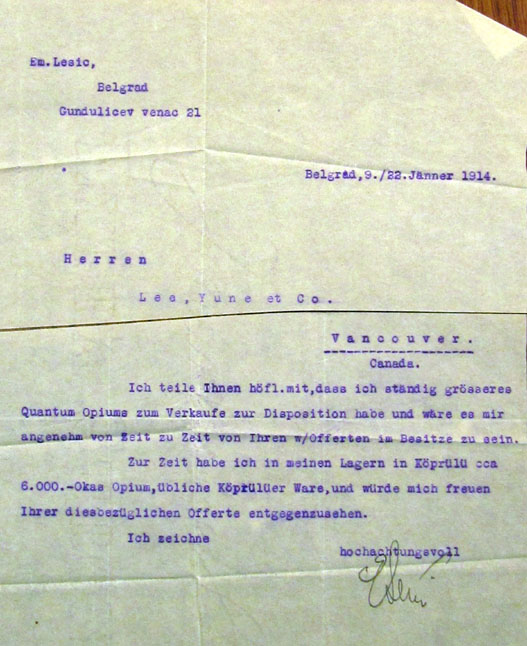
The first piece of direct evidence for such a connection that the editors have seen is a letter in the records of the Lee family, as preserved in the Chung Collection at the University of British Columbia. The letter is addressed to Vancouver’s Lee Yuen (or Yune) Company. As this earlier letterhead shows, Lee Yuen had been a significant opium refiner and seller before 1908, when the drug was banned in Canada.
The following letter, written in 1914 by E. Lesic of Belgrade [now in Serbia], is clearly an attempt at a blind sale and does not imply that the Lee Yuen Company stayed in the opium business after the drug became illegal. However, we may justifiably conclude that Lesic knew that at least some formerly legal Chinese dealers in Canada still sold opium secretly and that they were able to convert the high-morphine Balkan-Turkish variety of the drug into a low-morphine mixture suitable for Chinese smokers.
The letter is in German. It informs the addressee that the sender, Em. Lesic, regularly has large quantities of opium for sale and that he will offer it to the addressee from time to time. At the time of writing, he has 6,000 okas [16,500 pounds] of local opium available at his warehouse in Köprülü [now Veles, in the Republic of Macedonia] for which he would be pleased to receive orders. Here is the full text, transcribed:
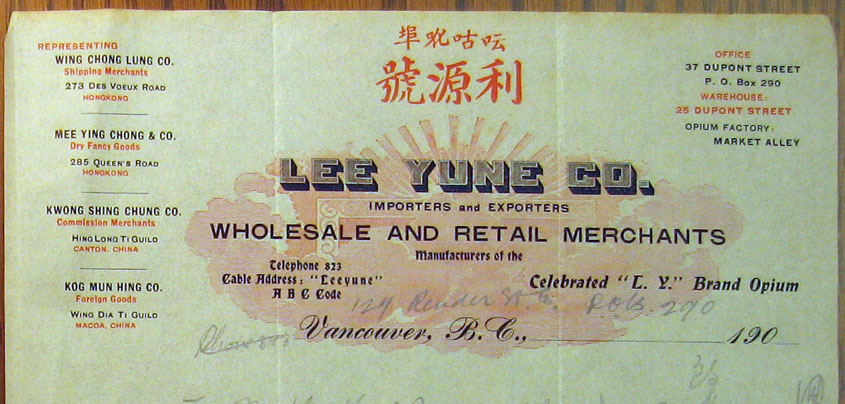
'Seller of the famous "L. Y." Brand opium'
Em. Lesic
Belgrad
Gundulicev venac 21
Belgrad, 9./22.Jänner 1914Herren
Lee, Yune et Co.
Vancouver.
Canada.
Ich teile Ihnen höfl.mit, dass ich ständig grösseres Quantum Opiums zum Verkaufe zur Disposition habe und wäre es mir angenehm von Zeit zu Zeit von Ihrem w/Offerten im Besitze zu sein.Zur Zeit habe ich in meinem Lagern in Köprülü cca 6.000.-Okas Opium, übliche Köprülüer Ware, und würde mich freuen Ihrer diesbezüglichen Offerts entgegenzusehenIch zeichne Hochachtungsvoll E Lesic[Note: Macedonia was part of Turkey until 1885. Opium was first grown there (in "Roumelia") in the 1840s using seed from Izmir, according to P. L. Simmons (“The Trade in Opium,” Bulletin of Pharmacy, February 1893, p 66. The 1911 edition of the Encyclopedia Britannica has more on Macedonian opium--see http://www.1911encyclopedia.org/Opium#Turkey)]
The illustrated items are from the Rare Books & Special Collections and University Archives of the University of British Columbia. The Lesic letter is from the Lee Fonds, Box 3, Folder 7. There are several copies of the Lee Yune letterhead in the same Fonds, Folder "1908 Steamship."
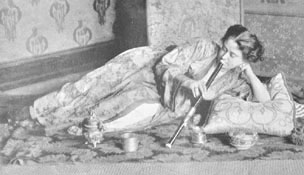
Lurid Pictures of Opium Dens
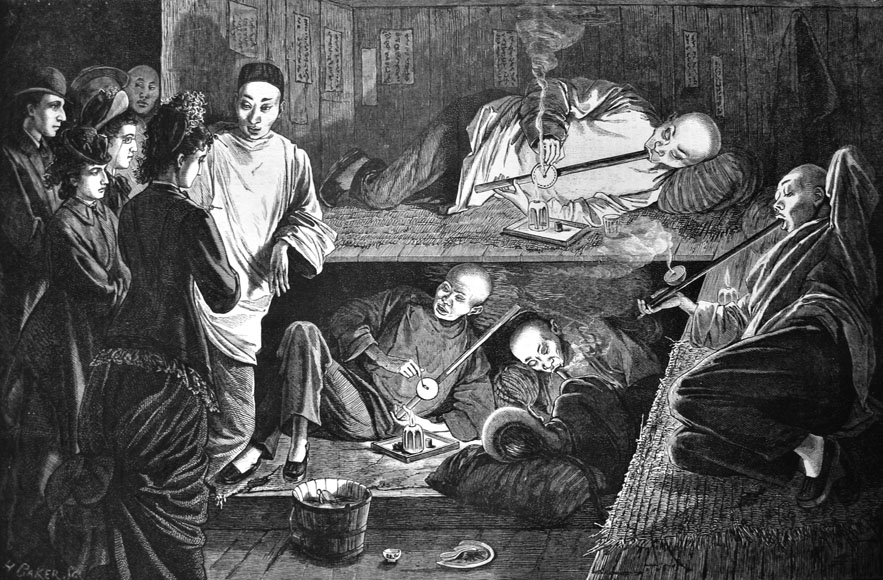
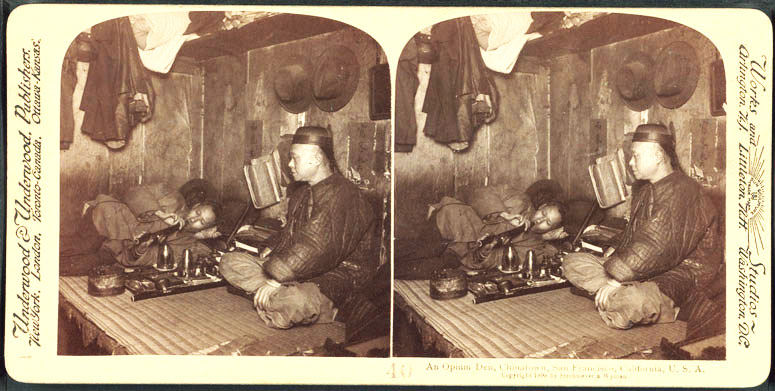
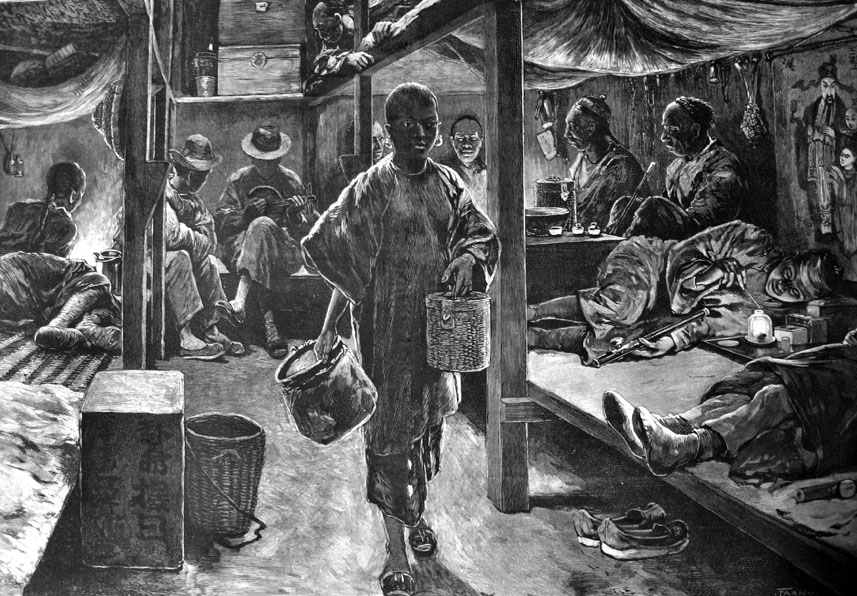
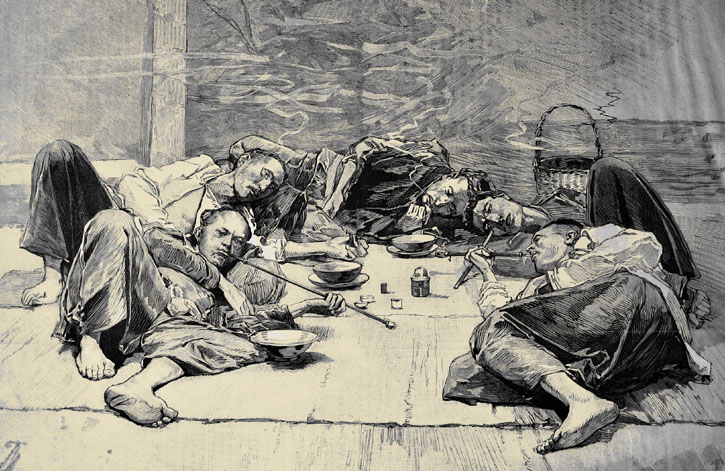
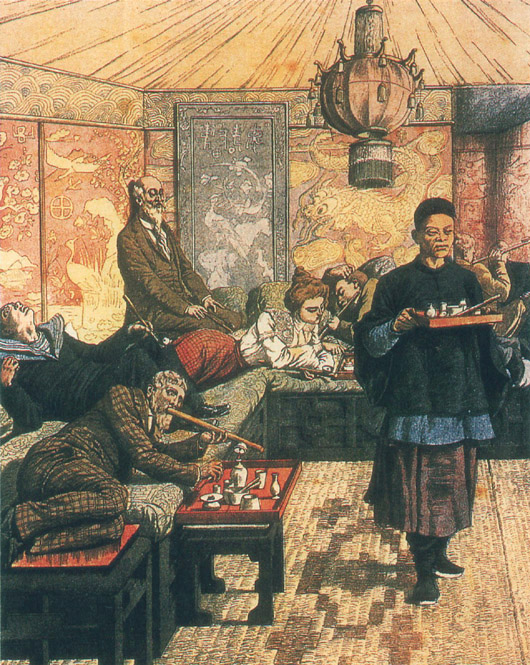
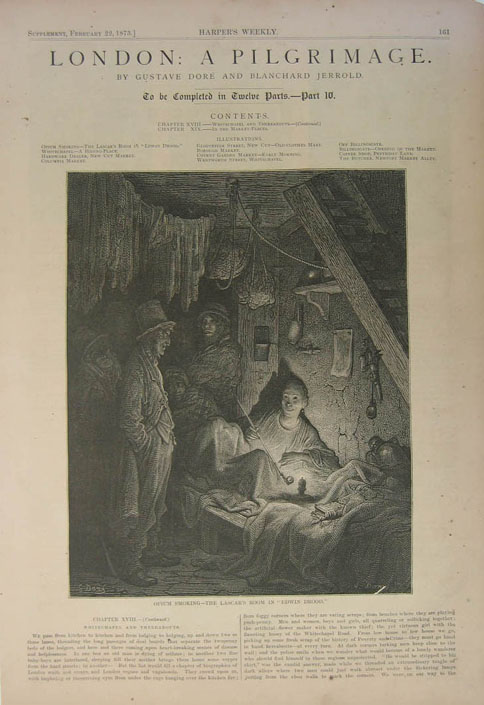
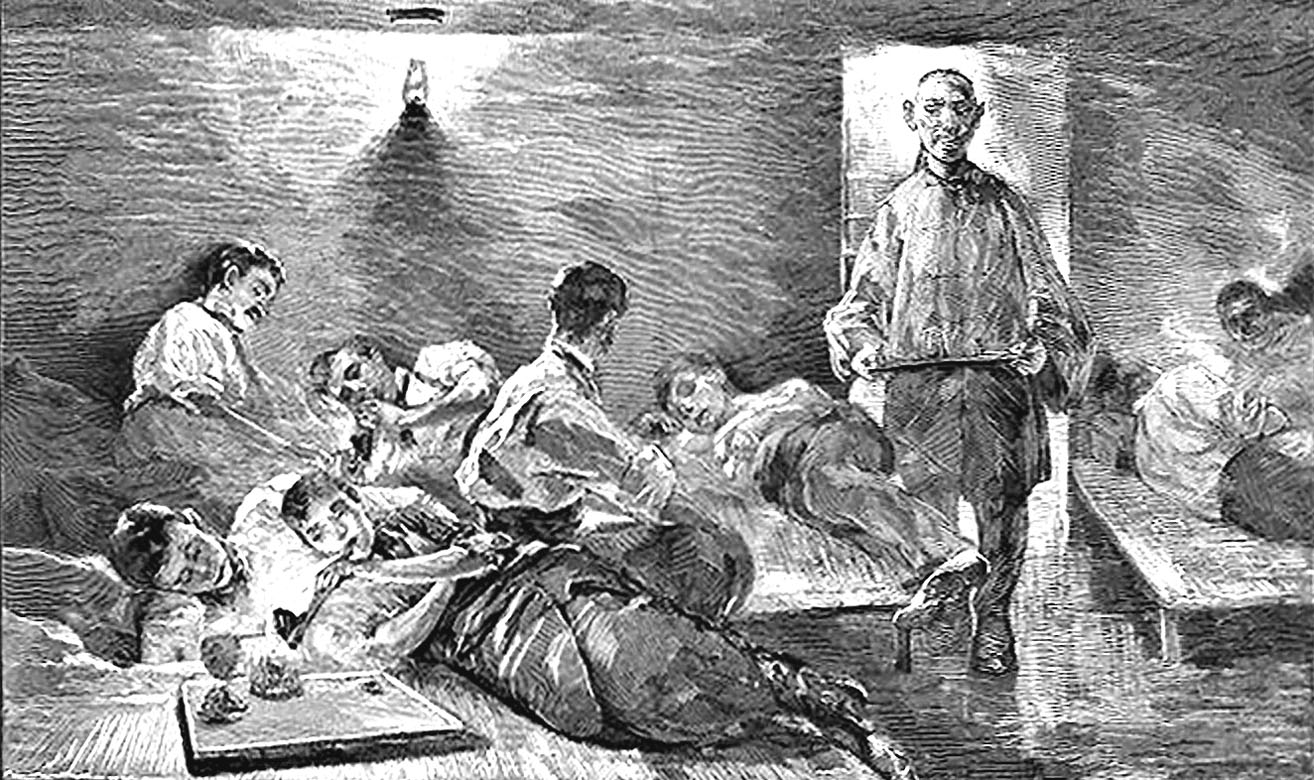
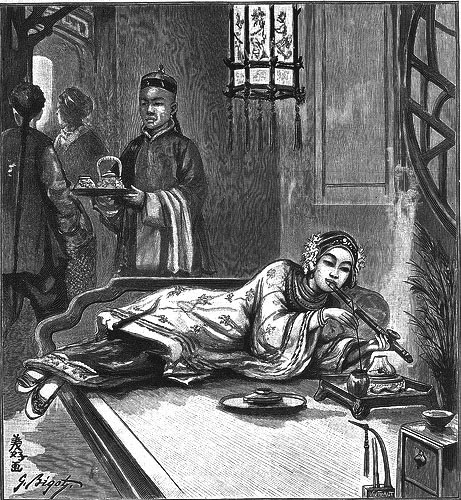
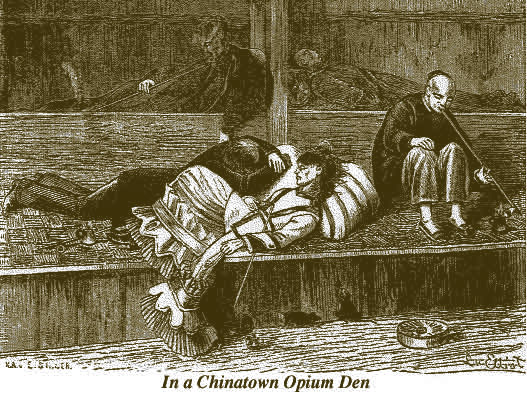
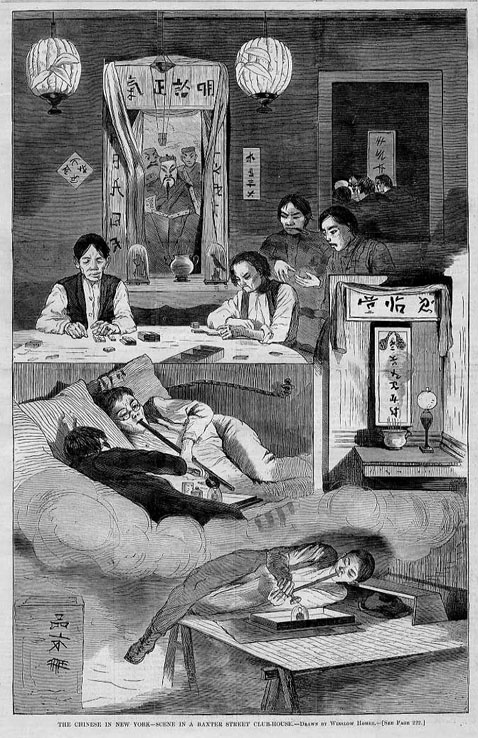
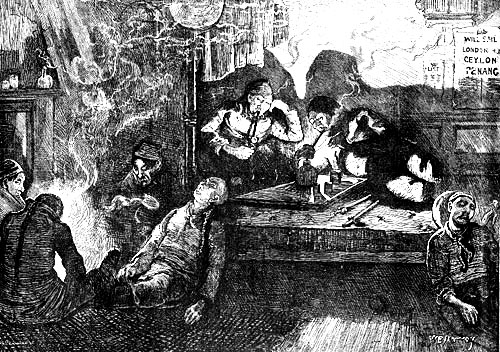
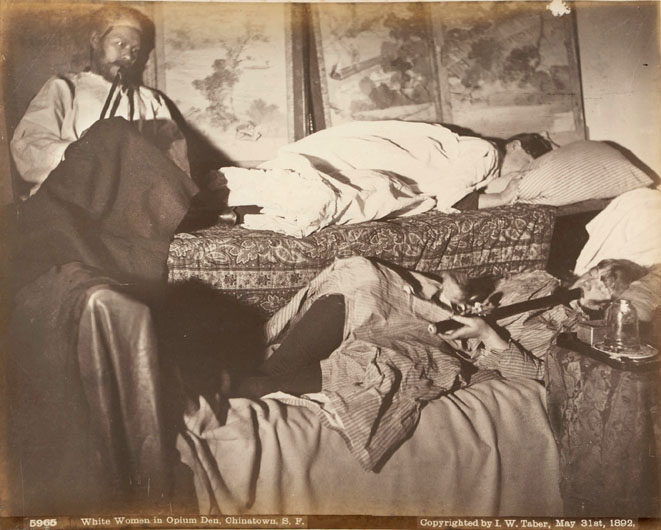
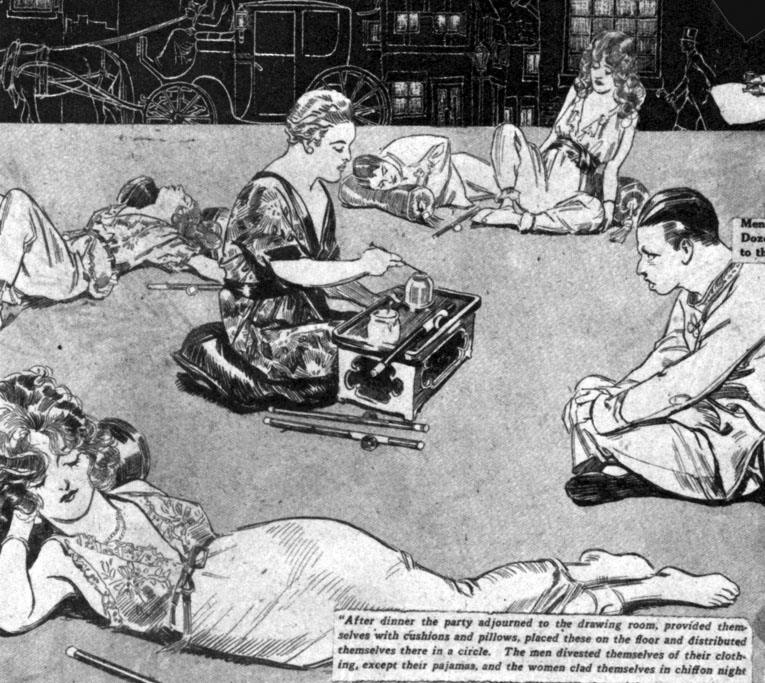
Presented below are some images of opium smoking establishments from 19th century publications. It will be seen that many are posed or entirely fictional, and that Chinese opium smokers are presented in much more negative terms than their Caucasian counterparts. Chinese (or wives of Chinese) are present in all images of opium smoking by whites.
Erotic treatments of opium smoking existed side-by-side with and were closely linked to anti-opium messages; in some cases the drug--intentionally or unintentionally--was made to be more, not less, attractive by those who in theory were crusading against it.
so quickly, or war leave half the desolation in its track, as we are told is the immediate result of forgetting for a few short moments the cares of life in the enjoyment of a pipe of opium. To such an extent is this language used, that strangers arriving in China expect to see nothing less than the stern reality of all the horrors they have heard described; and they are astonished at the busy, noisy sight of a Chinese town, the contented, peaceful look of China's villagers, and the rich crops which are so readily yielded to her husbandmen by many an acre of incomparable soil. Where, then, is this scourge of which men speak? Evidently not in the highways, the haunts of commerce, or in the quiet repose of far-off agricultural hamlets. Bent on search, and probably determined to discover something, our seeker after truth is finally conducted to an opium den, one of those miserable hells upon earth common to every large city on the globe. Here he beholds the vice in all its hideousness; the gambler, the thief, the beggar, and such outcasts from the social circle, meet here to worship the god who grants a short nepenthe from suffering and woe. This, then, is China, and travelers' tales are but too true. A great nation has fallen a prey to the insidious drug, and her utter annihilation is but an affair of time!
"We confess, however, we have looked for these signs in vain; but our patience has been rewarded by the elucidation of facts which have led us to brighter conclusions than those so generally accepted. We have not judged China as a nation from the inspection of a few low opium-shops, or from the half dozen extreme cases of which we may have been personally cognizant, or which we may have gleaned from the reports of medical missionaries in charge of hospitals for native patients. We do not deny that opium is a curse, in so far as a large number of persons would be better off without it; but comparing its use as a stimulant with that of alcoholic liquors in the West, we are bound to admit that the comparison is very much to the disadvantage of the latter. Where opium kills its hundreds, gin counts its victims by thousands; and the appalling scenes of drunkenness so common to a European city are of the rarest occurrence in China. In a country where the power of corporal punishments is placed by law in the hands of the husband, wife-beating is unknown; and in a country where an ardent spirit can be supplied to the people at a low price, delirium tremens is an untranslatable term. Who ever sees in China a tipsy man reeling about a crowded thoroughfare, or lying with his head in a ditch by the side of some country road? The Chinese people are naturally sober, peaceful, and industrious; they fly from intoxicating, quarrelsome samshoo, to the more congenial opium-pipe, which soothes the weary brain, induces sleep, and invigorates the tired body."
Herbert A Giles, Chinese Sketches, Preface, 1876; http://www.gutenberg.org/files/2133/2133-h/2133-h.htm. The image is owned by the Australian National University; the editors are currently seeking permission to reproduce it in a larger format.
Exaggerating Harm from Opium Use -- H. A. Giles, 1875
Giles, a Cambridge professor and the inventor of the Wade-Giles romanization system, had a tolerant view of opium smoking in China. While recognizing that the drug caused great harm, he denied that this harm was as great as anti-opium crusaders claimed. He joined other defenders of Chinese opium use in asserting that alcohol did more damage in Europe than opium did in China:
"Many writers on Chinese topics delight to dwell upon the slow but sure destruction of morals, manners, and men, which is being gradually effected throughout the Empire by the terrible agency of opium. Harrowing pictures are drawn of once well-to-do and happy districts which have been reduced to know the miseries of disease and poverty by indulgence in the fatal drug, The plague itself could not decimate
Famous artists join the war against Opium (and Chinese)
Degradation: Chinese opium dens in America
Less degradation: Chinese opium dens in Asia
Opium-based eroticism in Asia
Eroticism in opium dens for whites
Opium dens for non-Chinese
Gustave Dore, "The Lascar's Room in [Charles Dickens'] Edwin Drood," Harper's Weekly, 1873 Notice that Dickens' opium smoker is a Lascar (i.e.,, an Indian seaman), not a Chinese, The scene is fictional, supposedly in London's East End
Winslow Homer, "Scene in a Baxter Street Clubhouse," Harper's Weekly, 1874. Homer's details are accurate; he evidently saw opium being smoked in New York's Chinatown
Tourists in San Francisco's Chinatown, Leslie's Illustrated Weekly,1877. The details seem accurate, but the scene smacks of fakery nonetheless. Compare the good-looking white tourists and the ghastly Chinese.
Opium Den, San Francisco', 1874 A classic example of a depiction showing the evils of opium as used by degenerate Chinese. From Wiki Commons
Another San Francisco' opium den, 1870s. More fakery: the stems of the opium pipes are impossibly long, and the rats underneath seem to be included solely to show the depths to which the Chinese addicts and the slatternly white woman have sunk
Opium den, possibly in New York, 1880s(?) Posed but perhaps not faked: the opium smoker does not look unduly emaciated, and the man reading the book seems healthy enough. From the Robert Dennis Collection, WWII Commons.
Chinese opium den in Vietnam. The smokers are in clean surroundings and healthy-looking, possibly because at least one is smoking a tobacco pipe, not an opium pipe, L'Illustration, 1918. From Philip Choy collection.
Chinese opium den in the Philippines. Here too the surroundings are not so bad. The woman with the tea basket seems to be a Filipina. . From Harpers, 1888, Philip Choy collection.
Opium and Anti-Chinese Propaganda
Even back in the 19th century, observers often commented on the ironic fact that opium addiction, a vice for which Chinese were often criticized by Westerners, had been introduced to China by Western traders, mainly the British East India Company but also by American firms from Philadelphia, Boston, etc. Not so many observers, however, showed awareness that the existence of opium addiction was itself being used as a weapon against all Chinese through claims: that the natives of China were peculiarly susceptible, that Chinese addicts reached levels of degradation unmatched by other races, and that Chinese emigrants to Europe and North America tried hard to spread the habit to Westerners, especially the young and female ones, so as to drag them down to Oriental depths of depravity
We are not denying that some addicts were astonishingly depraved. While we find it difficult to believe that all Chinese addicts were any more pathetic in their enslavement to the drug than their white counterparts in Iowa and Albany, New York, we are sure that some became so badly hooked that they almost forgot to eat and that they were emaciated, unsanitary, and unpleasant to see. The question is, how common was this? Were North American Chinatowns filled with horrible-looking addicts? Was every other Chinese shop a front for an opium den?
1873
1874
1874
1870s
1877
1880s?
1888
1918
Opium den and/or brothel, China, 1900s. From Journal des Voyages, 1905, Philip Choy Collection
1905
1881
1890s?
Opium den in New York, Harpers, 1881. Meant to have erotic implications? All of the (well-dressed) smokers are white and male.
Opium den in France, from Wikimdia Commons. White French smokers may have preferred coed environments The room resembles a luxurious tent.
Opium den in San Francisco, IW Tabor, 1892, from Wikimedia Commons. The photo is faked, with a white man pretending to be Chinese, a Japanese screen in the background, and (decorously clad) girls smoking in an impossible way.
Opium den in London,1918, from a contemporary newspaper. The woman in the center is Ada Ping You, the Scottish wife of a Chinese addict and the center of a spectacular media scandal, reported eagerly on both sides of the Atlantic
1892
1918
版权 Copyright is free for non-profit use: click here for more info
Opium Suicides
Stresses were high in the get-rich-quick world of the California Gold Rush in the 1850s. The suicide rate was high too. A good many locals, white as well as Chinese, chose to kill themselves by swallowing opium, either in a liquid form like laudanum or, more often, as a solid. No one committed suicide by smoking opium. As pointed out elsewhere on this website, that was almost impossible due to the number of pipefuls needed (25-30 by most accounts), the time required to prepare each pipeful (about 5 minutes), and the extreme difficulty of staying awake long enough to smoke that much. Killing oneself by eating opium, on the other hand, was easy enough. It took an ounce or less. That quantity of the Chinese kind sold for 2-3 dollars retail, and the Middle Eastern kind, more potent because of a higher morphine content, was even cheaper. Both kinds were readily (and legally) available in local shops everywhere in North America. Considering that an opium overdose was thought to be a fairly pleasant death (much more pleasant than such popular contemporary methods as cutting ones own throat or drinking lye or acid), it is a wonder that more people did not use it.
Many did, however. Journalists in those days often noted that Chinese women were particularly prone to suicide by opium. The following table shows the journalists were right. The data comes from an online search of two 19th century California newspapers, San Francisco's Daily Alta California and Sacramento's Daily Union, whose early issues have now been completely digitized. Those newspapers' coverage of Chinese deaths in the 1860s-1890s was less thorough, and comparable information from the Pacific Northwest does not yet exist. But in both California and the Northwest between 1860 and 1900, the proportions of White : Chinese and male : female suicides would be roughly similar.
The list, of course, is incomplete. Many deaths in those days, especially of minorities like Chinese, were not reported in newspapers, and many others were reported without giving a cause, either because no autopsy was performed or, as was particularly true of white suicides, to avoid embarrassing the family of the deceased.
Nonetheless, it is clear that the number of Chinese women who killed themselves with opium was very high. There were at least five Chinese men to every Chinese woman in California in the 1850s, and yet there were three times as many opium suicides among Chinese women. Were there proportionally more suicides among Chinese women from all causes? We do not know but would not be surprised if that were so. Chinese of both sexes led hard lives in early California, but the women, many of whom were prostitutes and treated like bondservants if not like slaves, had it worse. One can only imagine the misery of those lives.
Most newspaper stories about Chinese suicides did not give details about motives. In a few cases, perhaps, one can read a little between the lines:
SUICIDE OF A CHINA WOMAN---A Chinese woman, named Ah Cam, committed suicide about eight o'clock last evening, by taking opium in a house of prostitution, kept by one Ah Hee, 226 Jackson Street [in San Francisco's Chinatown]. An inquest will be held upon the body today. The deceased was a native of Canton, and aged 20 years; had been in this country about one year. (Alta California 1856-08-21)
[SUICIDE OR MURDER?] Some time since a young Chinese woman died suddenly in an alley on Dupont Street, after being severely beaten by a Chinaman and his mistress. A port mortem examination disclosed the fact that the woman had died fro morphine, taken in burnt opium, from the bottom of a pipe. The woman had become useless from disease, and the supposition was that she might have been poisoned instead of committing suicide. (Sacramento Daily Union, 1857-05-13)
[SUICIDE FROM DEBT] A China woman, named Ah Kowu, committed suicide, on the 30th, ult., by taking opium. The only cause assigned for the deed was that she was considerably in debt, and some of her creditors threatened and importuned her. (Alta California 1857-11-05)
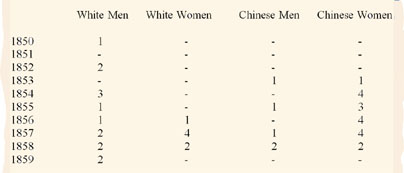
Opium suicides in California newspapers, 1851-1860
SUICIDE OF A CHINAWOMAN---Coroner Counts was informed yesterday, by an intelligent Chinaman, that a Chinese woman had committed suicide by taking poison [opium], on I street, between Second and Third streets... The witnesses examined were all Chinese and testified through an interpreter, that deceased was about 18 years of age, and that the act was probably superinduced by her receiving information from China that her father and mother had both been killed in war. (Sacramento Daily Union, 1858-03-24)
On the West Coast during the 19th century, reported suicides of both Chinese men and women were were often attributed to the death of parents or, in the case of men, wives.. Contemporary white men and women, judging from newspaper accounts, were less likely to kill themselves because parents had died but equally or even more likely to kill themselves due to the loss of a spouse or lover.
| ||||
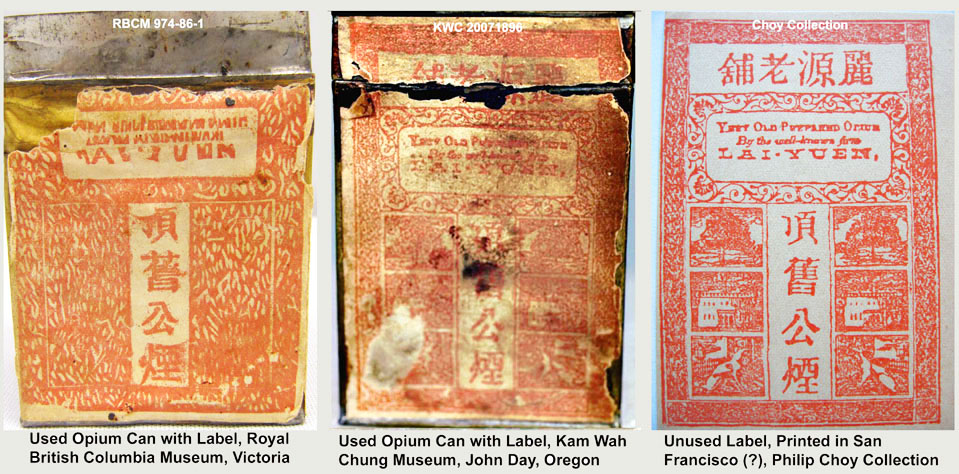
Commercial Trickery in Canadian Opium Labeling 冒牌烟罐商标
Another article on this website reproduces an advertisement that warns buyers to beware of counterfeits of Lai Yuen and Fook Lung, the two most esteemed (and highest-priced) brands of refined opium, imported from Hong Kong and, later, Macao. Actual fakes are hard to recognize. While opium cans with counterfeit labels, impressed seals, and customs stamps must have been fairly common, we may be sure that surviving examples were often made with the same skill and eye for detail that still cause Chinese forgers to be ranked with the finest in the world.
However, while complete fakes may be hard to identify, there were also more half-hearted attempts to fool buyers. One such attempt is shown here -- the label on a can of Canada-refined "Tai Yuen" opium that looks remarkably like the labels on Hong Kong-refined "Lai Yuen" opium, which retailed for almost twice as much. Both have vertical characters reading "top grade aged permit opium." Both also have three lines of English written horizontally, but in the case of the Tai Yuen product, the "T" of Tai is written so as to resemble an inverted "L," while the other two lines are in a mock alphabet--apparently, neither the printer of the label nor the buyer of the can could read Roman letters.
On the American side of the border, buyers could always look at an opium can's top, bottom, and sides for the Federal tax stamp, showing that customs duties had been paid. As will be shown in a future article on this website, customs stamps would have been difficult to counterfeit, and no importer could have been foolish enough to pay massive duties on a cheap, faked product. But in Canada, where legally imported Lai Yuen and Fook Lung opiums, though costly, were popular among smokers, and in the U.S., where smuggled Canadian opium sold for much less than the Hong Kong-refined brands, there clearly were marketing opportunities for sellers of a cheap product that looked more or less, but not exactly, like the more expensive kind.
The proprietors of opium-smoking establishments, who bought their opium several cans at a time, would not have been fooled. Neither would the richer smokers who bought entire (6 1/2-ounce) cans for their own use. But poorer smokers, who had to buy their drug in much smaller amounts and who must often have been already high when buying a few extra pipefuls, may not have been so alert to commercial trickery.
Tai Yuen was a respectable company: not only one of the biggest and longest-lived Chinese firms in British Columbia but -- as shown by the Governor-General's visit in 1895 -- one of the best-connected as well. Is it possible that such a well-regarded company would have designed its packaging so as to fool its customers? Could it have done this deliberately or was the similarity of labels an innocent coincidence?
Note: the first can is shown with the permission of Lorne Hammond, curator of history at the Royal British Columbian Museum in Victoria, BC; the second with the permission of Christina Sweel, director of the Kam Wah Chung Museum in John Day, OR; and the third with the permission of Philip Choy in San Francisco.
The same brands were smuggled into Australia as well. The Australian National Archives contains “two electrotype printing blocks with the trademark of ‘Lam Kee Macao Opium’ found in a packet in a drawer in the Revenue Detective’s Branch, Customs and Excise Office.” (Note 2)
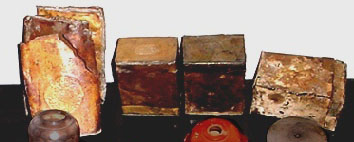
The examples shown here are from the collections of Reg and Roy at the North American Pioneer Chinese Virtual Museum in British Columbia, who say that the cans were found on Vancouver Island, perhaps in Cumberland
I was just thinking of Cumberland on Vancouver Island. There was a large active coal mine there from the late 1800s until mid 1900s. There were a lot of Chinese miners there. I have a pick head that came from there with a number on it and Chinese characters. They gave the Chinese miners numbers because the foreman was not expected to learn Chinese names. They would just yell number 19, when they wanted a specific miner. (I wonder if the white miners had numbers? Or did they say, "Hey Joe, you and number 19 over there go to drift 14"?)
The Macao cans came from Vancouver Island and were supposed to have been found in a railroad camp. Well, they were building railroads all over western Canada in the early 1900s, but these cans could also have come from Cumberland. They had a railroad going to that mine and there were Chinese camps there.
So if these Macao cans were later, then they could have come from there, for instance.
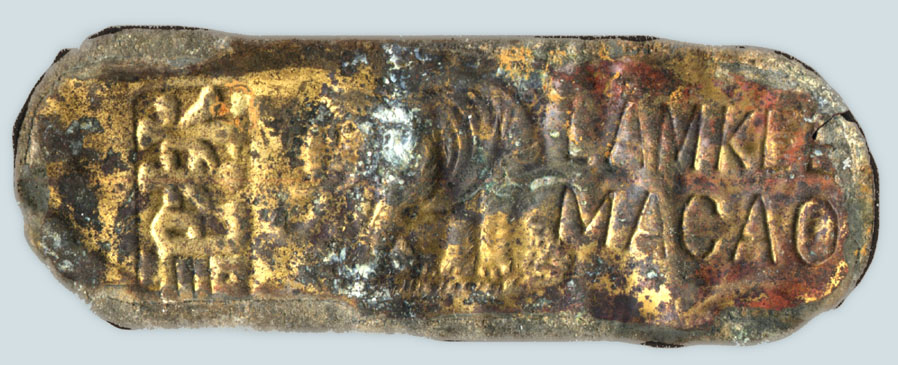
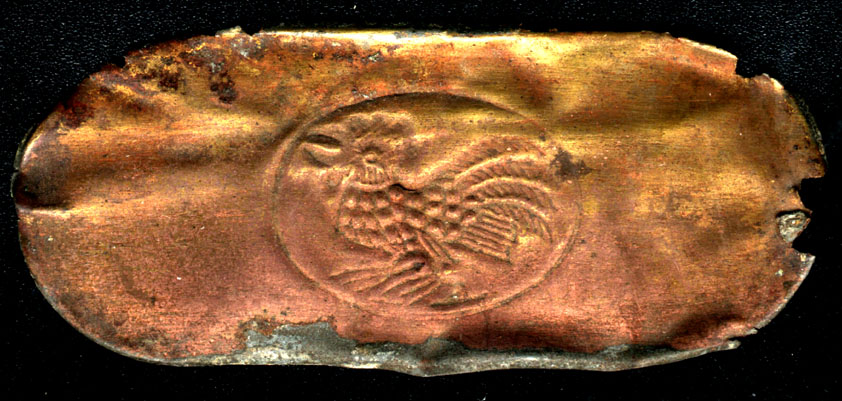
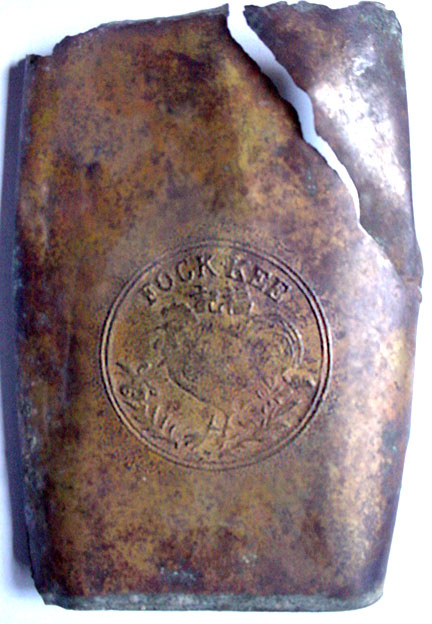
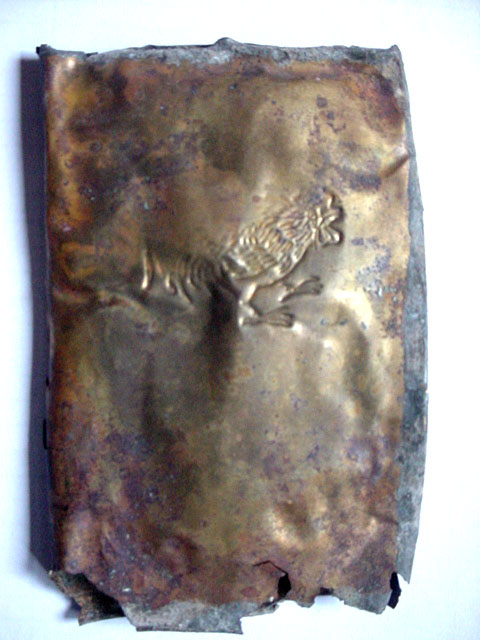
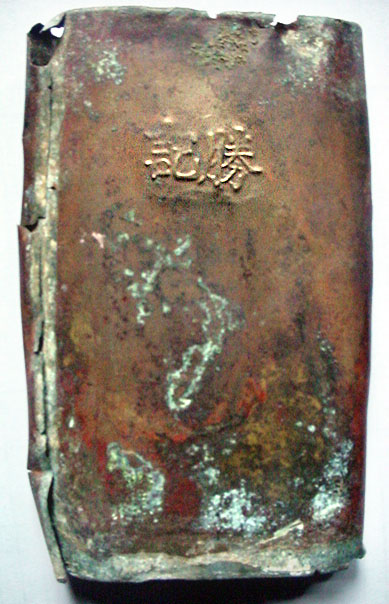
Lam Kee 林记 opium can top
Rooster brand opium can top
Fock Kee opium can side
Rooster brand opium can side
Sing Kee 胜记 opium can side
Oval (left) and rectilinear (right) opium cans
In an email to the editors, Reg speculates that Roy's cans may have come from the large Chinese settlement at Vancouver Island’s long-lived and productive Cumberland (Union Mines) coal mines:
The supervisors at the mines may have winked at their workers using opium. In the 1920s and 30s it was still common enough among westerners to feel that opium was not such a serious problem, especially when the users were Chinese.
Note 1: Roy Franklin Jones, Boundary Town [Blaine, WA], 1958; p 254; Jeff Jewel of the Whatcom County Museum showed us this book, which is quite rare.
Note 2: Frederick Thayer Merrill, Japan and the Opium Menace. New York: Institute of Pacific Relations, 1942, p 68.
Note 3: One tael = 1 liang (两, Chinese ounce), 1.33 English ounces, or 37.8 grams.
Note 4: U. S. Treasury Department. Traffic in Opium and Other Dangerous Drugs for the Year Ended December 31, 1941, p 8.
We learned later that Reg and Roy are probably right. Parts of two similar cans both made of brass, are on exhibit at the Cumberland Museum and Archives, where they were shown to us by Meaghan Cursons, the museum's executive director.
The second Cumberland can has a fragmentary paper label on its side, which reads "Lo [Old] Fook Kee" in English and Chinese. Its top is impressed with the rooster logo and the base, with three seals "Lam Kee Hop [Box]," "Sing [Cheng]" and "Jum." The last two may be names of the owners or the makers of the can; the presence of Lam Kee and Fook Kee on the same box might show that the two brands were owned by the same company.
Now, it is no surprise to find that opium labeled "Macao" was being shipped abroad in the 1910s though the 1930s. Although opium was illegal in many countries by then, the Portuguese rulers of Macao still permitted it to be refined within the colony and to be exported to foreign countries. They seem not to have been overly concerned that authorities in those countries saw opium as a grave social problem. One is more surprised, however, to learn that France, or at least local French officials in Kwang-Chou Wan (which they spelled Kouang-Tchéou-Wan), had an equally unconcerned attitude. According to a contemporary American authority on narcotics (Note 2), the French colonial government's
We do not know where the lion-branded opium can was made. Like the others shown above, it could have come from Macao. However, the Lo Fook Kee example may well derive from somewhere else: that is, from the tiny French quasi-colony of Kwang-Chou Wan 广州湾 (now Zhanjiang 湛江) on the coast of China west of Macao. Our reason for thinking so is that Frederick Merrill, quoted below, said that "Lu Fook Kee" was a Kwang-Chou Wan brand.
"Opium Régie [Opium Authority] retains the monopoly on the importation of raw opium, but it permits certain licensed manufacturers within the colony to prepare opium for retail sale. A number of five-tael tins (Note 3) bearing the Régie stamp have been seized by United States narcotics agents. In 1939 the following brands were turned up: "Lam Kee," "Lu Fook Kee," "Yick Kee," and "Lem Kee Ying," all of which are blends of Iranian and Chinese opium.
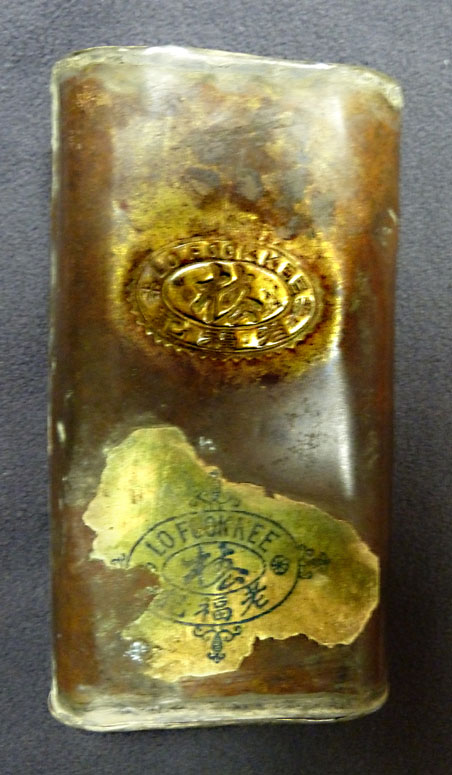
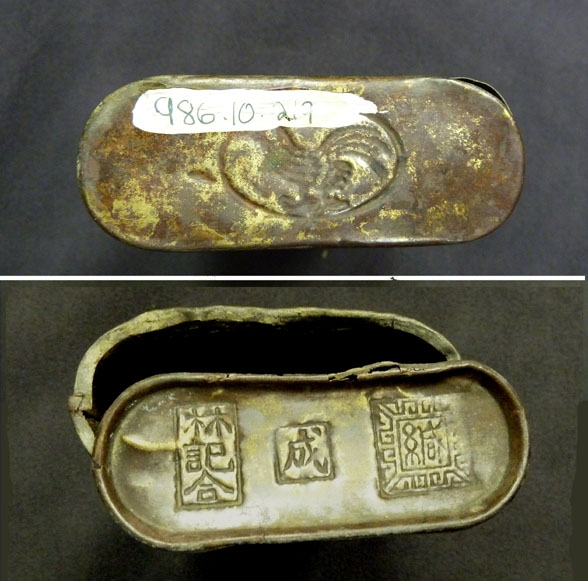
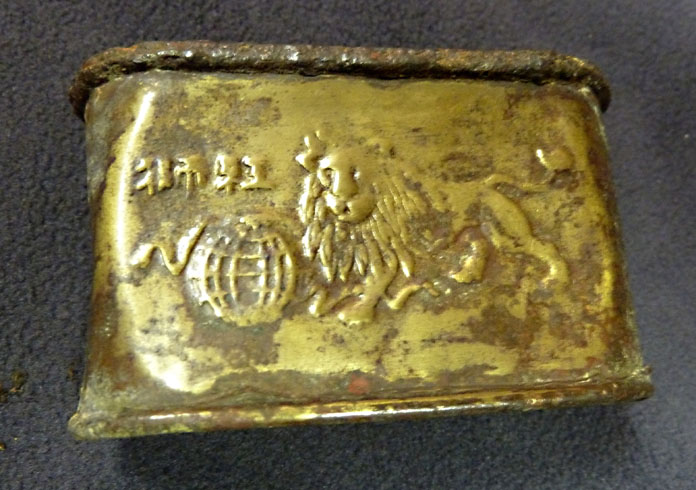
Only part of the first can survives. On its side are the embossed words "Wang Shi 旺狮" [Fierce Lion] and a European-style crowned lion with a globe.
The official 1942 report of the U.S. Bureau of Narcotics (Note 4) observed that on opium cans captured from smugglers,
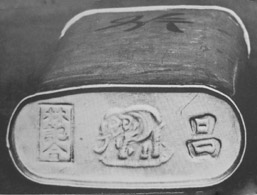
The marks most commonly encountered were "LAM KEE" (ROOSTER AND ELEPHANT), "RED LION" (1-tael tins) (note 2) and "LAM KEE YING" (Eagle brand, 1-tael tins) in both the Atlantic and Pacific coast areas. These tins were similar to those alleged to be manufactured in and exported from Macao and the French leased territory of Kwangchow-wan.
In one instance at Baltimore, Md., the tins seized bore stamped impressions of both the "YICK KEE" and "ROOSTER NO. 1" brands, heretofore considered as separate brands. However since both of those familiar brands are said to originate in Kwangchow-wan, it is possible that the assembling was done in the factory at that port
Kwangchow-Wan Brands and the French Connection 法属广州湾烟罐
Note 1: New York Times 1925-11-24 p 24, 1927-11-27 p 29, 1930-5-25 p 62
Note 2: National Archives of Australia website: http://74.125.155.132/search?q=cache:f4htIZg4OmMJ:www.naa.gov.au/naaresources/Publications/ research_guides/pdf/chinese_guide.pdf+%22Lam+Kee%22+opium&cd=7& hl=en&ct=clnk&gl=us
Chinese Miners at Cumberland 加拿大卑斯省金巴仑煤矿华工烟罐
Note: Reg is the webmaster of the North American Pioneer Chinese Virtual Museum, based in Williams Lake, B.C.
Even More Opium Brand Names, from Idaho's AACC
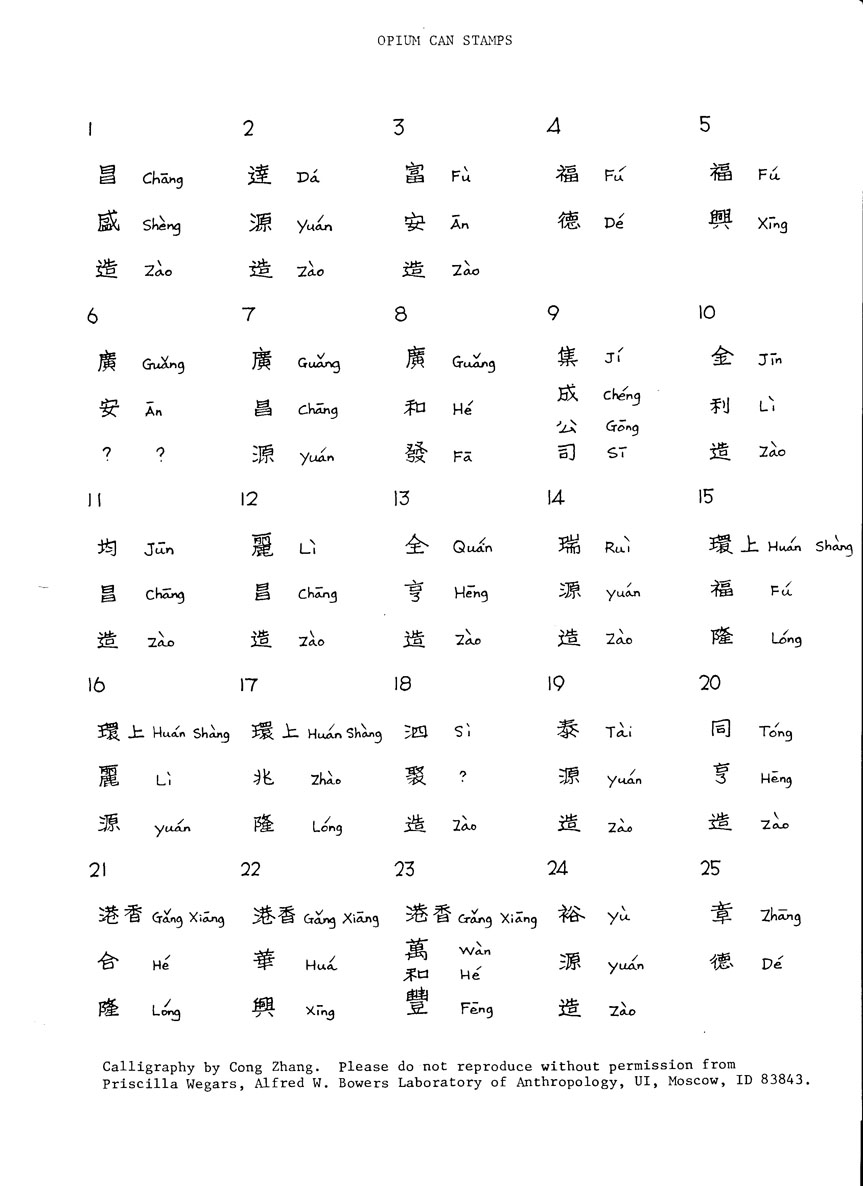
This list of seals from the tops of excavated opium cans was compiled in the 1990s by Priscilla Wegars of the Asian American Comparative Collection in Moscow, Idaho. It is reproduced here with her permission. The calligraphy is by Cong Zhang.
Wegars tells us that only one seal in the collection was found in Canada -- a Tai Shun/ Tai Soong/ Tai Xun example excavated at a mining camp on the Fraser River in 1989. All the seals on this list come from cans found in the United States, including Numbers 6, 7, 11, 16, 18, 19, and 20, all of which also occur at Canadian sites. Numbers 6, 7, and 19 represent the brands of well-known refineries in Victoria, showing definitively that Canadian opium labeled as such did reach markets on the American side of the border.
Presumably American customs officials did not have such seals read when discovered on confiscated opium cans. They might otherwise have seized on the presence of those cans to show what they had long suspected but could not prove, that Canada was a source, and not just a way-station, for opium smuggled into the U.S.
An expanded listing of opium brands, with more names and Cantonese-Taishanese versions added, can be seen by clicking here
(Click on image to enlarge)
1880
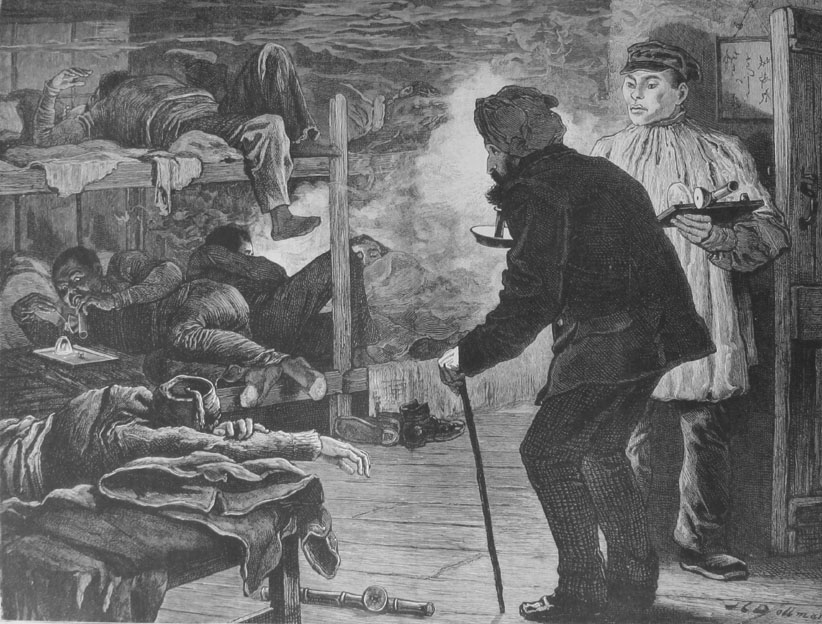
Opium den in London's East End,1880, from a contemporary magazine. The artist;s choice of smokers shows that opium addiction was still in 1880 thought to be mainly a vice of non-white peoples. The customers include an African, a Middle Easterner (wearing a fez), and an Asian Indian (standing). The Chinese server holding the tray was a stock character in such images
Paper Labels on Opium Cans
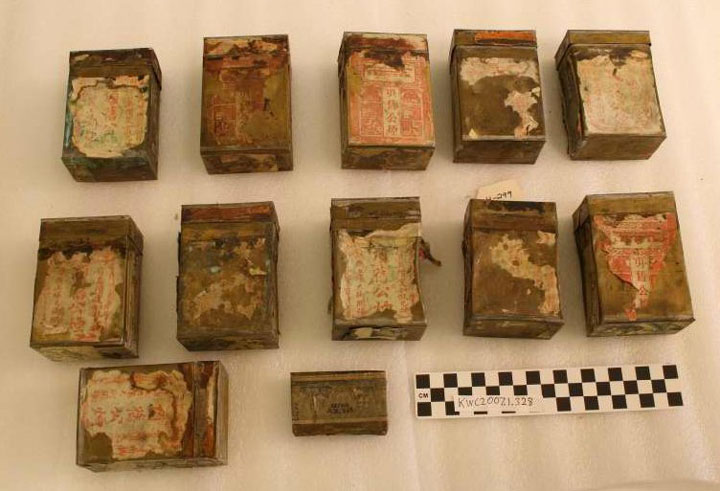
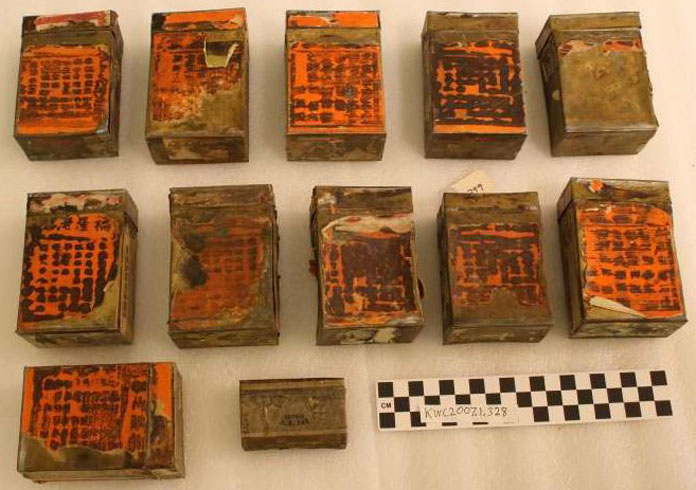
By far the best collection of opium cans with intact labels is that of the Kam Wah Chung Museum in John Day, Oregon. The reason why the collection is so good is that one of the owners of the Kam Wah Chung Company, Doctor Ing Hay (pinyin: Yu Wuxue), was something of a packrat. He seems to have hated to throw things away. Hence, during the 61 years he worked and lived at Kam Wah Chung, he accumulated a remarkable quantity of American Chinese artifacts, including many opium cans. We know he sold opium back when it was legal, before 1909 -- several ledgers in his handwriting survive with details of opium sales.
Did Doc Hay use opium himself? We do not know. However, the fact that all of the empty opium cans found in the store after his death were for the two most expensive brands of the drug, Lai Yuen 麗源 and Fook Lung 福隆 (for more on these, click here), indicates that the main user or users were quite well-to-do. Considering that most Chinese in the John Day area were not rich, one suspects that a long-term owner of the company might have been one of those users.
There were two such long-term owners: Doc Hay himself and his partner Lung On (pinyin: Liang Guanying). Both were active, successful businessmen, and Doc Hay was a busy, well-regarded herbal doctor as well. If either was an addict, his addiction clearly was not so severe as to impair his day-to-day functioning. Moreover, both lived long and apparently healthy lives. Lung On died in 1940 at the age of 77, and Doc Hay was 89 at his death in 1952. Does this show that neither was in fact an opium addict? We will leave that for the reader to decide [but see Note 1].
Left: Front. Right: Back. On the left, the whiter labels are for Fook Lung and the redder ones for Lai Yuen. The photo-graphs were taken by Christina Sweet, the curator at Kam Wah Chung, They are used here with her permission.
Interestingly, the labels were affixed in the United States and may have been printed there as well. Philip Choy's collection includes a number of Lai Yuen labels in unused condition (for an example, see the next article). He acquired them in San Francisco,
Note 1. According to Jeffrey Barlow's and Christine Richardson's well-researched book (China Doctor of John Hay, Binford & Mott Publishing, 1979, p 45-46), Doc Hay was an opium smoker in 1905 (when the drug became illegal in Oregon), and may have continued to smoke for some time after that. The present editors believe that there may be more information about Doc Hay's own opium use in his Chinese-language ledgers of opium sales, two of which have survived. We will add more on this at a later date.
The Addict's Progress: Anti-Opium Propaganda in China, 1883 戒烟宣传品
Vigorous efforts to combat opium addiction began quite early in China. An example is shown here, combining traditional cartoon-like graphics with a strong message, here translated into English. Propaganda of this kind is believed to have reached North America, including the Pacific Northwest, by the 1880s or even before. This example appeared in the British magazine, The Graphic, 1883-10-20.
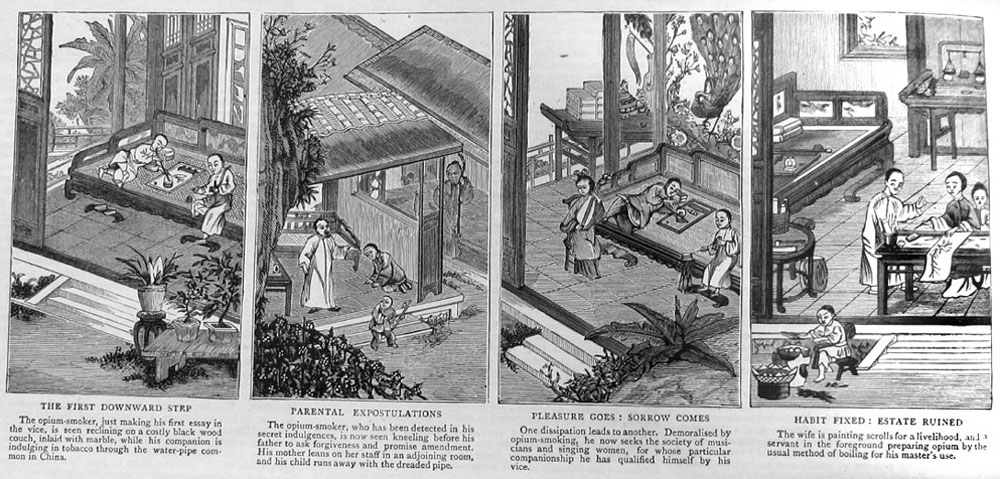
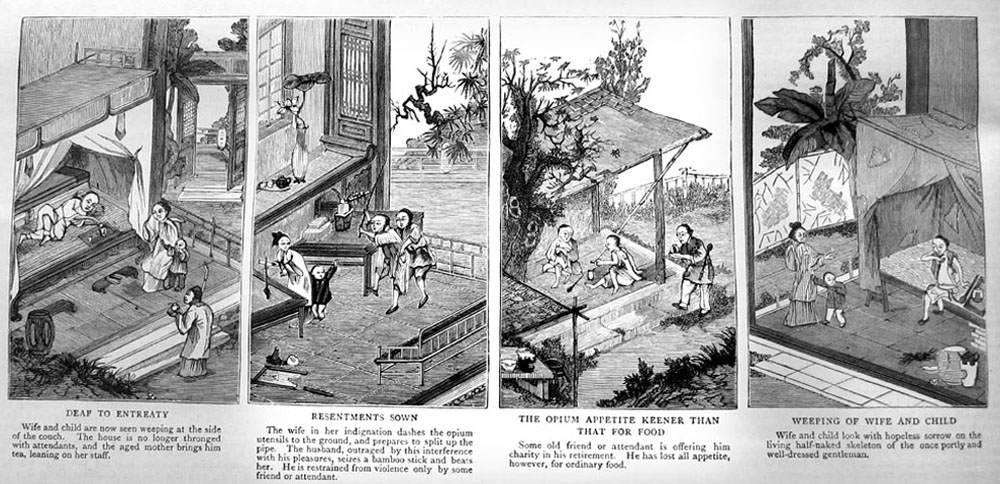
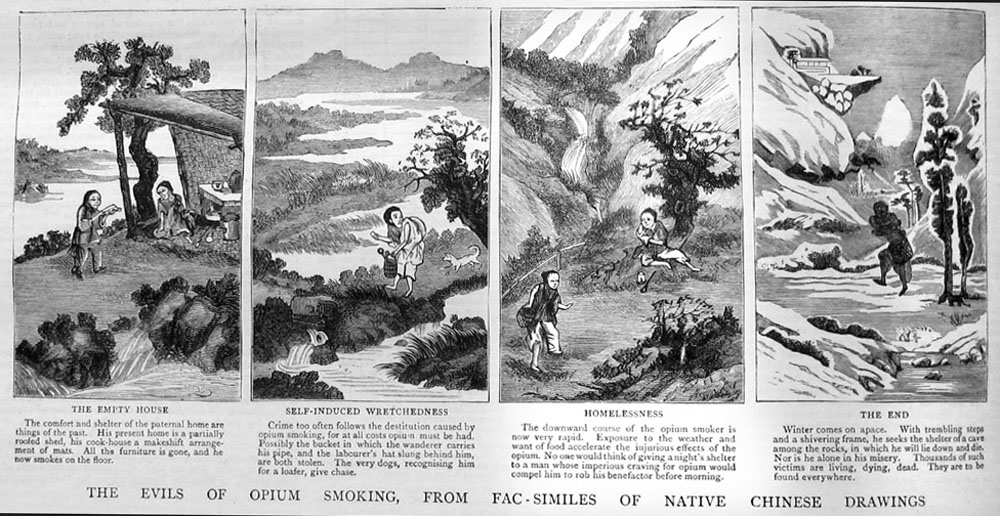
The editors especially like the caption of Frame 3: "Demoralized by opium smoking, he now seeks the companionship of musicians and singing women, for whose particular companionship he has qualified himself by his vice." Having grown up in the hippie era, we can remember the earnestness with which the older generation denounced "drugs, sex, and rock-and-roll."
12 3 4
2 3 45 6 7 8
6 7 8910 11 12
10 11 12The minister in question was Lionel Sackville-West, Minister Plenipotentiary to the U.S. and something of a free spirit who, though very much an aristocrat, did not always act or talk in the most diplomatic way. He must have visited Portland in September 1883, after witnessing the driving of the final spike in Henry Villard's Northern Pacific Railroad tracks connecting Portland and Seattle with the Midwest. Many of the laborers on the NP, like those who worked on the earlier Central Pacific, were Chinese. It is possible that Villard's connections with Chinese labor contractors in Portland led to Sackville-West's experiment with opium.
Click here to add text.
A British Ambassador Smokes Opium in Oregon, 1883 英国大使在钵崙戏食鸦片
Zhang Yinheng 張蔭桓, better known in North America as Chang Yen Hoon, kept a diary during his years as Chinese Minister to the United States (1886-1889). In it he recorded that on July 1, 1887,
"West, the British Minister [Zhang's counterpart in Washington diplomatic circles] paid me a visit. He talked about having a good time in Portland [Oregon] with the Chinese there and even tried smoking opium for fun. I asked him why America did not outlaw opium smoking, now that there were many Americans taking opium as well. The ambassador told me that in Europe many women take opium in pill form, coated with sugar; their consuming style is not as refined as that in China." [Note 1]
Interestingly, Sackville-West seems to have been more tolerant about opium use than was Chang.
Note 1: Zhang Yenheng, San Zhou Riji 三洲日记[Diary of Three Continents], published 1896 Section 1, 30th day, 5th month, Guangxu 12 (July 1, 1887)
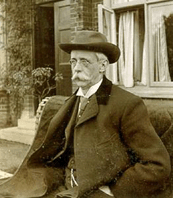
Sir Lionel Sackville-West
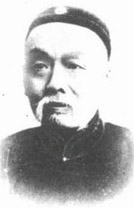

Zhang Yinheng
金山西北角 - 华裔研究中心
A Prepossessing Young Widow (and her Daughter) from Port Angeles, 1895
Hattie Stratton, caught smuggling opium from Victoria to Port Townsend in 1893, was not the only youthful white woman to be tempted by profits from free-enterprise importing. Two years later, Margaret Morrison, "a prepossessing young widow whose father is a prosperous farmer near Port Angeles," also was arrested by customs officials in Port Townsend and charged as a professional smuggler:
"Opium valued at $100 was found concealed about her wearing apparel. She was accompanied by her twelve year-old daughter, on whose person four pounds of opium were discovered. While coming across from Victoria the inspector imagined her figure was unusually plump, and upon inspection five tins of the drug were found ingeniously secreted in her balloon sleeves. At the Customs House she fainted and went into hysterics, and requested that her daughter be sent outside into the open air, Hardly had her child reached the sidewalk when she began running and crying, throwing dozens of cans of opium into vacant lots. Later Mrs. Morrison, in consideration of similar charges not being presented against her daughter, pleaded guilty and is detained in prison. The officers claim the woman has been regularly engaged for several months in smuggling opium for a Chinese firm." -- Ironwood (Mich) News Record 1895-12-21
It seems to us that the Morrison drug bust, although small potatoes compared with the half-ton of opium smuggled by Suzy Ying Kao in 1929, would have been worth more than a paltry $100. Consider this: Margaret's daughter had four pounds (= 8 standard half-pound cans) on her person. Margaret herself had five more tins, ingeniously concealed in her balloon sleeves. And then either the daughter or Margaret--it is not quite clear which--threw "dozens" of cans into vacant lots as she ran along the sidewalk. Assuming that "dozens" means at least two dozen, and adding in the 8 plus 5 cans found on their persons, this comes to a minimum of 35 cans. Valued conservatively $6 per can, which is what cheap opium sold for in the 1890s, this comes to more than $200.
It may seem strange that Customs would have low-balled the estimate. After all, then as now, customs and anti-narcotics officials regularly exaggerated the value of seizures. But it must be remembered that opium fell into a special category in those days--it could be auctioned off by the office that seized it and the profits retained by the office, partly to be distributed as a bounty to the officials involved. Under the circumstances, it may have made sense to keep the published value low.
A last comment: whereas Hattie Stratton was a free-lancer like most early opium smugglers, risking her own money and gaining bigger profits thereby, Margaret Morrison is said to have been smuggling "for a Chinese firm." Does this mean she was a mere "mule," carrying drugs belonging to someone else? That could be so. On the other hand, the writer may only have meant that she sold her wares to a regular Chinese customer, presumably a Port Townsend or Seattle company.
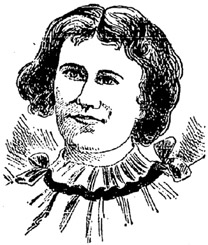
Margaret Morrison
This page was last updated: August 15, 2019
Opium Cans from Australia: The Hong Kong-North American Connection
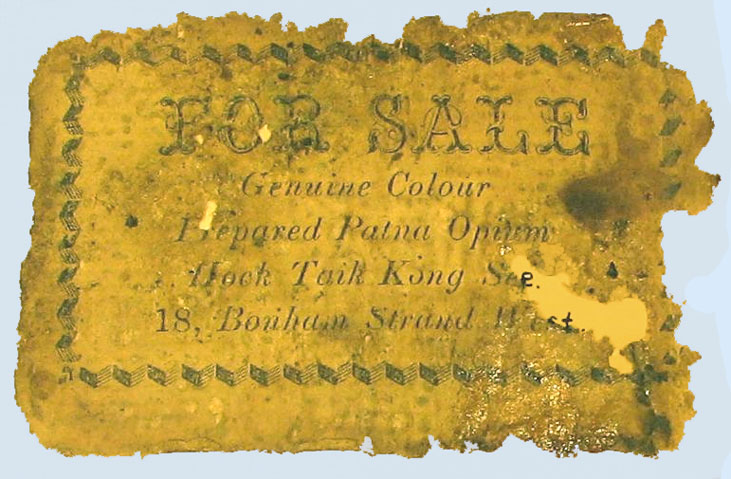
At last--hard evidence that Hong Kong opium refiners shipped the same products to places other than North America. This example comes from Australia. It was sent to us by Rob Grant of Chillagoe in Queensland, who found it while metal detecting in the north Queensland mining town of Montalbion (ca. 1880-1900). The brand name 福德 Fook Duk (Cantonese) or Fude (Mandarin/Pinyin), also appears on cans from Grant's Pass in southern Oregon (now in the collection of Reg and Roy in Williams Lake, British Columbia--click here for picture) and in Priscilla Wegars' Asian American Comparative Collection in Moscow, Idaho.
The label, which is entirely in English, may have been printed in Australia. It gives the Fude brand name as Hock Taik, which is more or less its pronunciation in the Hokkien (=southern Fujianese or Minnanese) Chinese language.
The Chinese miners in that part of Queensland, unlike their peers in the western U.S. and Canada, almost all of whom were from Guangdong, must have come from Fujian province.
The label also tells us where the company was located: on Bonham Strand, which is in Hong Kong's Sheung Wan 上環 district, like the producers of the Lai Yuen and Fook Lung brands. It would seem that Sheung Wan, now a respectably middle-class wholesale and retail shopping area, once had an international reputation for the quality of the opium refined there.
The phrase 公司 Kong See (Gongsi in Mandarin/Pinyin) means "Company." The poppy fields of Patna and Benares (= Varanasi) in eastern India were controlled by the British colonial government. Chinese smokers considered opium from these sources the best in the world.
Rob asks what the black ink mark means. We don't know (it is not Chinese) but are equally curious. If any of our readers have ideas, we would like to hear them,.
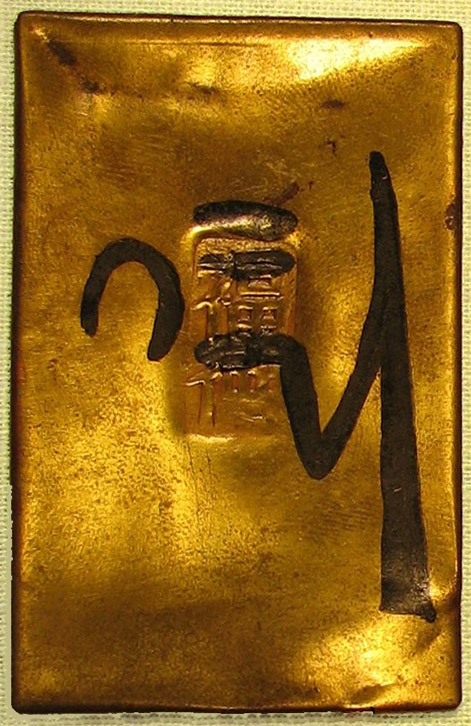
Top of can with Fook Duk seal and unknown ink mark
Paper label showing the Fook Duk/Hock Taik brand name
Opium Pipe Bowls from Australia: Yet More Evidence of a Hong Kong-North American Connection
More Australian Opium Cans Showing a Hong Kong-North American Connection
Amazing! Rob Grant has just forwarded photos of opium cans found at Queensland sites by a friend of his, Duncan Ray. Of five cans with cartouche seal impressions, four read "Sheung Wan Fook Lung" (PY: Shangwan Fu Long). This is the familiar Fook Lung 福隆 which, along with Lai Yuen 麗源, were the most widely smoked brands of high-quality imported opium in both the United States and Canada. Duncan's fifth can has a cartouche that reads 香港萬和 蘴 "Hong Kong Man Wo Fung" (PY: Xianggang Wan He Feng). That brand is quite rare on this side of the Pacific. Priscilla Wegar's list of brands in the Asian American Comparative Collection does include one example, however, and we have seen another that was excavated in the Cariboo area of British Columbia . The presence of both brands is further proof that Australian Chinese got their opium from the same Hong Kong and Macao sources as did Chinese in America and Canada.
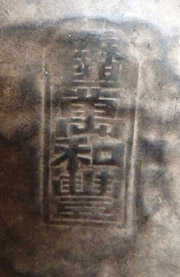
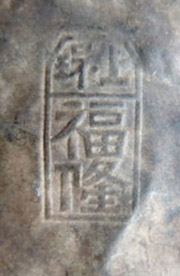
Opium can lids from Chinese sites in Queensland. Photos and objects from Duncan Ray
Closeups of seal cartouches from Duncan Ray's opium can lids. Left: Hong Kong Man Wo Fung. Right: Sheung Wan Fook Lung.
Even more amazing. Thus far the editors have seen closeups of only three opium pipe bowls from historic Chinese sites in Australia. Yet of those three, two represent a brand name that we have seen before in the United States. This seems to mean not only that the same wholesale suppliers in China, probably in Hong Kong or Macao, exported opium equipment to both North America and Australia but that the suppliers got their equipment from the same sources within China.
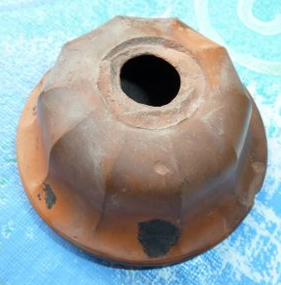
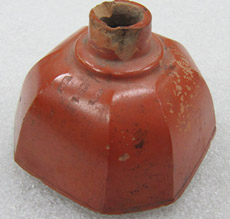
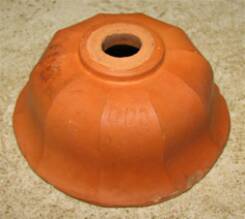
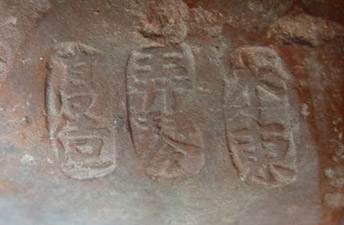
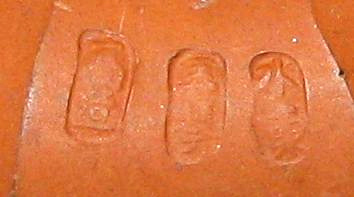
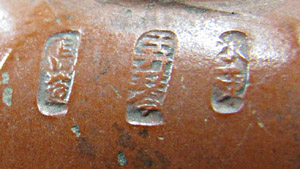
Shui Dong Opium Pipe Bowl, Queelsland, Australia. Duncan Ray, collector & photographer
Shui Dong Opium Pipe Bowl, Queensland, Australia. Rob Grant, collector & photographer
Shui Dong Opium Pipe Bowl, Boise area, Idaho. Idaho Historical Society collection
These all have the same six-character inscription on the base. From left to right and top to bottom, they read Shui Dong ["Water East," probably a place] Long Qin [" ___ Zither," either a brand name or Gao's personal name] Gao Zuo ["Gao Made," the maker's name].
So little has been published about makers of opium pipe bowls that we can only guess where these come from. The fine red clay fired at a medium temperature is similar to the material used for making teapots at Yixing in Zhejiang province and Shiwan in central Guangdong province. Moreover, as another article on this website shows, both centers produced opium pipe bowls for export. But these do not look quite like Yixing or Shiwan products, and it is clear in any case that a number of kiln centers in China made pipe bowls using similar clay. So where could these have been made? One possibility is a kiln center named Shui Dong, that still exists, within he city of Chaozhou in eastern Guangdong. Nowadays Shui Dong makes glazed wares, but the Chaozhou area has long been known for also making Yixing-type tea wares with clay bodies that look much like the bodies of these pipe bowls.
In any case, it would seem that in the late 19th century, much of the opium and opium equipment exported for from China for use by overseas Chinese came from only as few sources. Why this should have been so is not clear. The overseas Chinese in question, mostly miners and laundrymen at that period, often had a good deal of money to spend. So one might expect that merchants in richer Chinatowns would have tried to stock a wide variety of luxury goods to tempt their customers into spending more. Yet it seems they did not. And those Chinatowns held a good many merchants large enough to import goods themselves, choosing those goods from the enormously diverse markets of Hong Kong, Macao, and China itself. Yet, as far as opium went, diversity was minimized. Most merchants carried the same kinds and brands as their competitors. We do not understand why.
The best-dated opium cans with brand names anywhere?
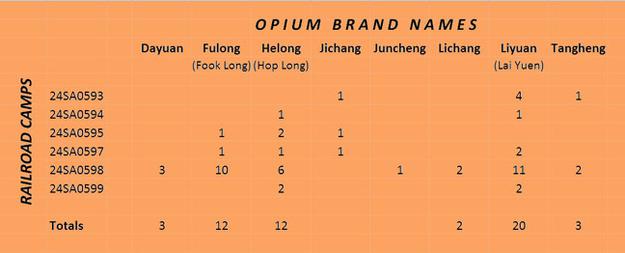
The explanation may lie in the history of competition in the Hong Kong opium industry. In 1882, as pointed out in another article on this website, the wealthy firm that produced Lai Yuen and Fook Lung opium merged with its rival, the equally wealthy producer of the Hop Lung brand. It seems quite possible that, as in the case of modern corporate mergers, the new firm decided to focus on certain brands while cutting back on others. The Hop Lung brand may have been among the casualties, in or shortly after 1882. Montana was too far away in space and time for say such change in the opium supply to have been visible before 1883 at the earliest. And yet the relative scarcity of Hop Lung cans at other North American sites where Chinese used opium suggests that the change did take place, presumably once local supplies of Hop Lung opium had run out.
Another interesting fact is that the railroad workers also smoked several minor brands of imported opium: Dayuan, Jicheng, Juncheng, Lichang, and Tongheng. The sample size is too small to be certain, but it does seem that the minor brands were used at the same sites as the major brands and that some smokers at all sites used minor brands. How is this to be explained? We know that opium smokers, like modern whisky drinkers and cigarette smokers, were highly brand-conscious. It is therefore unlikely that the person who supplied opium to railroad workers—almost certainly, the Chinese contractor who had hired that particular group of laborers—could have treated this opium as an undifferentiated commodity, sending any kind that happened to be available and expecting the laborers to be satisfied. The supplier must have attempted to accommodate the laborers’ tastes. This may well explain the presence of the minor brands side by side with the well-known (and expensive) Lai Yuen, Fook Lung, and Hop Lung.
Gary Weisz of Sandpoint, Idaho, has just shown us the opium can lids he collected at a series of isolated sites along the Northern Pacific railroad in western Montana. The sites were temporary camps for the Chinese workers who built that part of the railroad in 1881-1883. All are too confined or too difficult to reach by any route, except by the railroad itself, to have been used as maintenance centers after the rails had been laid and train service had begun. Hence, the sites almost certainly were not in use before 1881 or after 1883. which makes the objects found at them one of the most tightly dated assemblages of overseas Chinese artifacts anywhere. Chinese mining sites often lasted a decade or more and are hard to date precisely anyway. Many Chinese residential, commercial, and institutional sites in the U.S. and Canada continued in use for at least several decades, meaning that associated artifacts cannot be said for sure to have been used at the same time or at any given date.
So we naturally were delighted to see Mr. Weisz’s material. It contains information about the early opium trade that, as far as we know, cannot be gotten anywhere else.
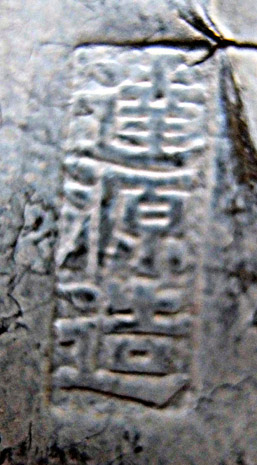
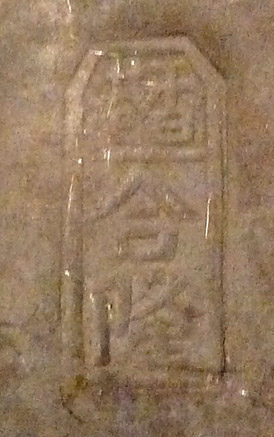
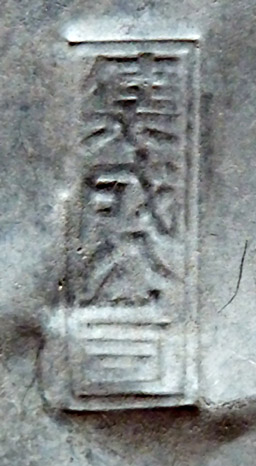
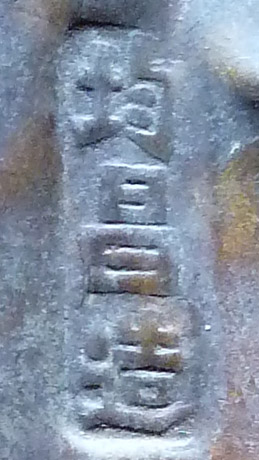
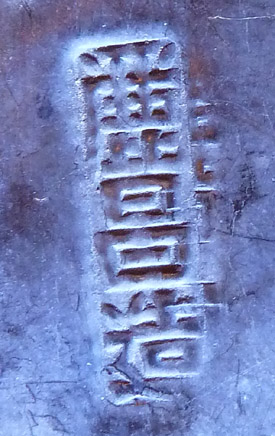
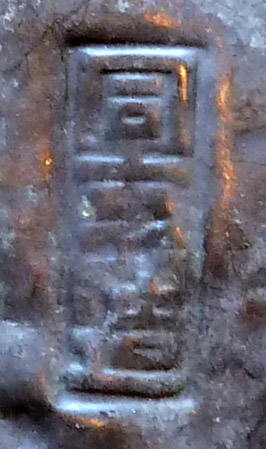
"Xianggang Helong" or
"Hong Kong Hop Lung"
"Dayuan Zao"
"Jicheng Gongsi"
"Junchang Zao"
"Lichang Zao"
"Tongheng Zao"
The following table tells the story. Six camps along this particular stretch of the railroad yielded opium tin lids with readable brand names. All are those of Hong Kong refining firms—apparently, in the early 1880s Victoria was not yet exporting its own refined opium, at least not in cans marked with Canadian brand names.
Two of the most common brands were the same as at many other North American sites, Liyuan/Lai Yuen 麗源 and Fulong/Fook Lung 福隆. One or both of these brands dominate most in-situ assemblages of commercial opium containers, as at Kam Wah Chung in John Day, Oregon. But at Weisz’s sites, a third brand, Helong/Hop Lung 合隆, seems to have been almost equally popular. We have not seen this at any other site.
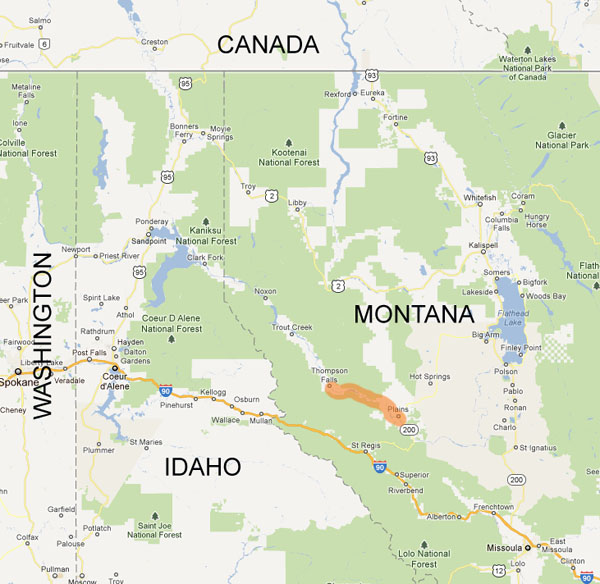
Location of Weisz's Northern Pacific sites, 1881-3
Six early railroad camp sites along the railroad's original route yielded opium can fragments with brand-name cartouches: froim west to east. Thompson River (24SA0593), East Eddy (24SA0594), East Weeksville (24SA05945, "Fu Sang" (24SA0597), "Taklamakan" (24SA0598), and Perma Bridge (24SA0599). The site numbers are those assigned by Christopher Merritt and Gary Weisz when registering the sites with the Montana State Historic Preservation Office.
The opium cans and other artifacts from these sites represent surface collections. None of the sites has been excavated.
The map comes from Google, with modifications
[Note that Gongsi means "Company" and Zao means "Made by." For Liyuan and Fulong seals, click here]
| ||||
香港合隆
逹源造
集成公司
均昌造
麗昌造
同亨造
For a full list of known brand names
Marketing Opium to White Americans before 1914
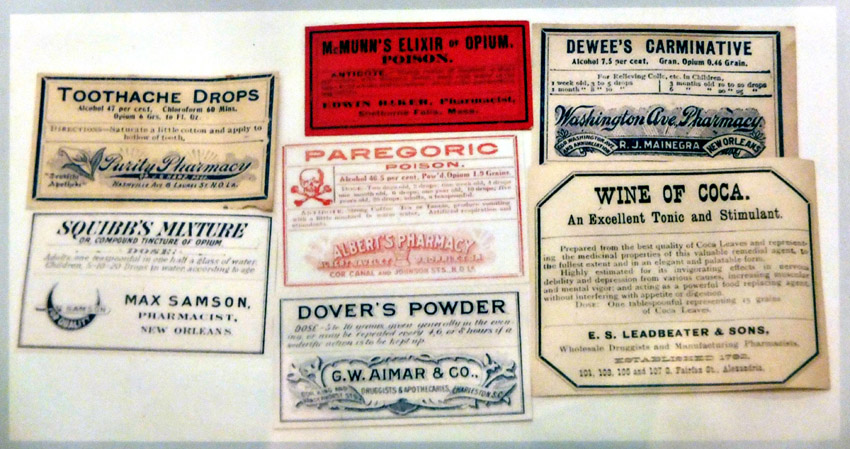
While American Chinese often had trouble getting opium, even where it was legal, white addicts had no trouble at all. Until the Harrison act of 1914, they could buy any opiate drug without a prescription. Most pharmacies sold them. And even after 1914, various "exempt" opiates, including codeine cough medicine and paregoric, would not be legally restricted for another fifty years. Only in 1970 did codeine and paregoric begin to be listed as prescription drugs that could not simply be sold over the counter with no records kept..
Purity Pharmacy Toothache Drops 0.38 grams opium/fluid ounce
Squibb's Mixture opium content not given on label
McMunn's Elixir of Opium formerly "of the strength of laudanum" (1)
formerly "of the strength of laudanum" (1)Albert's Pharmacy Paregoric ca. 0.1 grams opium/fluid ounce
G. W. Aimar, Dover's Powder max. daily dose ca. 0.5 grams opium (2)
Dewee's Carminative ca. 0.030 grams/fluid ounce (3)
Leadbeater's Wine of Coca no opium content
(1) http://chestofbooks.com/reference/Encyclopedia-Of-Practical-Receipts-And
-Processes/Elixirs-Part-7.html
(2) a standard 19th century formula according to Wikipedia
(3) for children
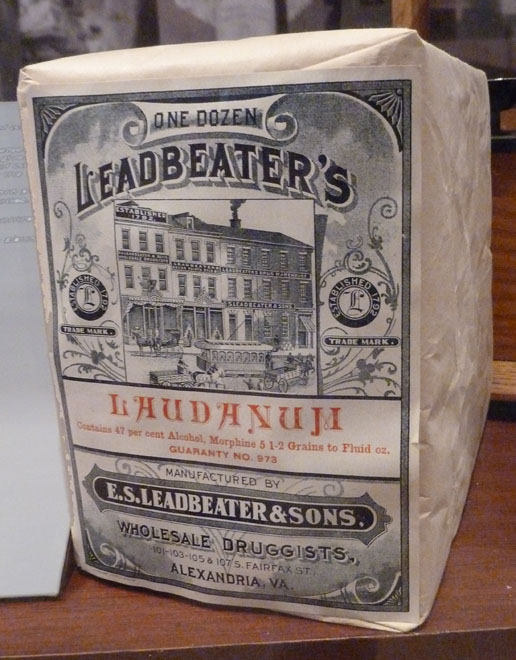
Leadbeater's Laudanum 0.4 grams morphine (= ca. 1.6 grams opium) per fluid ounce. According to Kane (see next article), in the 1890s, the average white addict consumed 1.3 grams of opium per day
The following photographs were taken in an exhibit at the Drug Enforcement Administration's museum in Arlington, Virginia. As in the case of Chinese opium cans, labels from European-American opium bottles and jars are much rarer than the containers themselves.
 | ||||
| | | ||
| ||||
Manufacturers of patent medicines containing opiates were evidently well aware that addicts were their main customers: notice that a fluid ounce of Leadbeater's laudanum contained just about a day's consumption for an addicted user. A few manufacturers may have been more principled, however. For instance, it is hard to believe that any manufacturer of Dover's Powder, containing the violent emetic ipecac as well as opium, could have aimed their products at ordinary dope addicts. Only exceptionally addicted individuals, one imagines, would have been willing to undergo violent, painful vomiting several times each day just to get enough of the drug.
And in any case, patent medicines seem not to have been nearly as important in white addiction as opium in less processed forms. The preceding article notes that Hull's survey of drug use in Iowa in 1885 showed that a sample of 235 addicts obtained their opiates from local drug stores in the following forms.
26 injected morphine
129 swallowed (or sniffed?) morphine
73 swallowed gum (raw) opium
12 drank laudanum
6 drank paregoric
3 swallowed Dover's powder, and
4 drank McMunn's Elixir
Source: J.M. Hull 1885--see preceding article
The high percentage of morphine users at such an early date is interesting. But so is the fact that only 7 of 235 addicts got their opiates from patent medicines. It is possible that opium-containing over-the-counter medicines were not as much of a social (and medical) problem in those days as is sometimes claimed.
We do not know whether American Chinese addicts used opium-containing Western patent medicines. In later years many did switch to injectable morphine and heroin. They must also often have used Turkish gum opium bought from white American stores. Although, as noted elsewhere on this page, the Turkish product contained too much morphine to be smokable, it still would have been useful as a medicine and to satisfy one's cravings when smoking-type opium was not available.
3
(UNLESS OTHERWISE STATED ALL DATA ON THIS PAGE COMES FROM THE EDITORS' OWN RESEARCH ON PRIMARY SOURCES & ARTIFACTS)
Opium Cans from the Prohibited Period - 1909 年禁烟以后的洋烟罐
A change in opium cans took place during the 1910s and1920s, after the drug had been legally banned in most countries, including China, Britain, the United States, Australia, and Canada. Whereas formerly refined opium had always been sold in rectilinear 5-tael containers, now it was being sold in flat cans with oval tops and bottoms, rather like an old-fashioned Prince Albert can, once a popular American brand of pipe tobacco. The amount inside was changing too. By the 1930s, in the U.S. at least, opium cans sometimes contained one rather than five taels, and sold for a much higher price.
The principal brands used by overseas Chinese in the 1910s-20s seem to have been Fook (or Fock) Kee and Lam Kee, both refined in Macao and packed in cans with embossed bilingual English-Chinese texts and trade marks in the form of animals, including roosters, eagles, and lions.
"Lam Kee" and "Lam Kee Hop," which may be identical, appear quite often as Macao brands in contemporary newspapers One New York Times article called Lam Kee "the most expensive of smoking narcotics" (Note 1).
Cumberland, BC: Lion Brand opium can
Cumberland, BC: can with Fook Kee label on side
Cumberland, BC: same can with Lam Kee impression on top
Blaine, Washington: Can, probaby seized from smugglers, with Lam Kee and elephant impressions (Note 1)
Lam Kee's Opium Factory in Macao
What may be the only extant English-language description of a Macao opium refinery occurs in a work of fiction--in a novella that appeared in a California newspaper in 1923. The factory, which the writer must actually have seen, belonged to one "Lam Kee." The writer seems to have assumed that in Macao, as in Chinese North America, businessmen could be called by the same name as their firms.
"In an Opium Factory
"Lam Kee's opium factory was not an impressive place. It was located in the native [i.e., Chinese] section of Macao near the waterfront and was composed of long wooden buildings, about which were stacked piles of poppy stems and leaves, the wrappings taken from the imported [Indian] product. . .
"Almost nude coolies, carrying great bundles of dry opium, brushed past them and dumped their burden into big vats, under which fires blazed continually. Others bore ladles of bubbling black, tarry stuff to the strainers, where it was put through still another process, finally reaching the canning stables [sic], where it was injected into containers and the labels pasted on, making it ready for export or for domestic consumption. . .
"Lam Kee . . . and the other opium factory owners, working as a syndicate, purchased their products at the monthly auctions held at Calcutta, British India . . . Of course there was a negligible amount of Chinese stuff smuggled down from the Yunnan and Kweichow provinces, but this hardly paid to bother with. The raw opium came from Calcutta to Macao in junks and in larger steamers.
"The payment of a large price to the Portuguese owners of Macao for the concession also entitled the syndicate to establish a certain number of shops where hopheads could go to smoke and where dope was sold over the counter like tobacco or any other legitimate product. The local sale at Macao however absorbed only a small portion of the total amount fabricated. The greatest quantity went to the smugglers.
"He revealed to them how the squatty seaport colony spewed forth enough opium to poison the world of the Pacific from the Indian Ocean to the Bering Sea, and from the wilds of Tibet to the heart of the United States, Canada, Mexico, and South America. . .
"Lam Kee did not care if the smugglers transshipped their cargo of black stuff onto big oceangoing ships at Hongkong, from which it would be smuggled ashore at San Francisco, Seattle, Los Angeles, Portland, and at Canadian ports." Note 1
Note 1. Oakland Tribune 1923-05-23
Note 2. Phoenix (AZ) Republic 1936-01-19. The same story, titled "Lone Wolf Hanks," ran in several other contemporary newspapers.
Melvin Hanks, the customs agent who went under cover to break a syndicate that smuggled Lam Kee opium into the U.S. in the 1930s. A pile of oval opium cans is next to him. Note 2

